ECHO Collective connects and empowers refugee and immigrant women providing opportunities for personal growth and cross-cultural relationships. With a grant from the Lincoln Arts Council, ECHO is offering a weaving class to women and children using SoulCollage® as a springboard for a tapestry design. In the first session, we explored the power of their unique stories, reflected with images to create a SoulCollage card, and discussed how weaving their stories together can bring healing. Mothers, teens, and young children participated, including my youngest ever–a two-year-old sweet girl particularly attracted to images of white bunnies. For several weeks, participants will learn weaving techniques to create their own and a community tapestry.
“The promise of peace comes through story. When we are willing to bear witness to one another, to take other’s and joy seriously, to listen deeply, with full attention, to tell other’s stories over–we reweave the bonds of civil society.“- Rabbi Dr. Ariel Burger
St. Andrew’s Episcopal Church hosted a women’s retreat titled “SoulFully You: Many Ways to Pray” that focused on finding God in music, movement, nature, words, and creativity. Richard Rohr writes, “We are already in the presence of God. What is absent is our awareness.” Twenty participants practiced Lectio Divina with the poem I Happened to Be Standing by Mary Oliver and learned how to create mandalas. Group discussions, journaling, and prayerful activities highlighted the wisdom of Simone Weil, that “pure attention is prayer.”
If you begin to live life looking for the God that is all around you every moment becomes a prayer.” -Frank Bianco
For more information about SoulFully You retreats, see upcoming retreats held at St. Benedict Center and possible retreat themes here. If you are interested in having a retreat or workshop created for your organization, church, or special interest group, contact me here.
Choosing a word to focus on each year has become a nourishing, soulful ritual. I savor the word, that more so chooses me, throughout the year—it brings great joy when in perfect synchronicity, it appears over and again in what I read, hear, and see. I trust that the word, as it settles in my heart, will be a guiding light for months to come—challenging, inspiring, and transforming me.
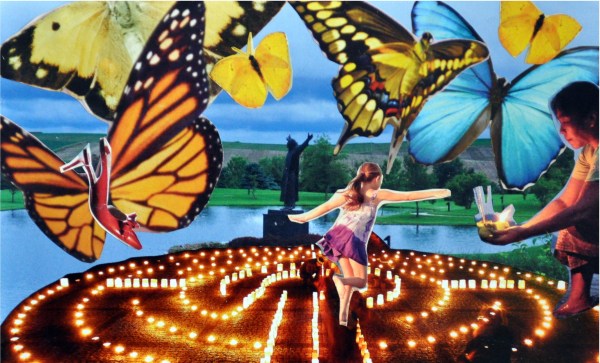
My 2024 word of the year, FULLY, is a throwback to ten years ago when I birthed and named my first website and creative venture, SoulFully You. I participated in training to become a certified SoulCollage® facilitator, to lead retreats on creativity and spirituality. As a Marketing teacher, creating a brand name felt like the best first step. With my daughter Jessica and her friend Claire (both students of my high school classes) we brainstormed a variety of words, phrases, and combinations, and then it clicked, that “aha moment” of knowing I have come to trust—SoulFully You. I loved what it meant, and still do. The image at the top of this page, a SoulCollage® card to represent SoulFully You, came later.
Being SoulFully You is living with purpose, on purpose; being attentive to the present moment; practicing gratitude; making good choices and having no regrets; living with death daily before your eyes, as St. Benedict writes; and leaving something beautiful from a life well-lived. It is living life to the fullest, using the gifts and talents you have while being open and responsive to opportunities and surprises that come your way.
A tree gives glory to God by being a tree.
Thomas Merton
Being SoulFully You is discovering and becoming all that God has created you to be. Thomas Merton writes, “For me to be a saint means to be myself.” The call to be holy is the call to be more fully myself, just as a tree gives glory to God by being a tree.
Michael Casey, a monk of Tarrawarra Abbey, writes in The Road to Eternal Life that following the teachings of Christ “asks no more and no less of us than that we become what God intends us to be, that we cease acting a role and allow ourselves to become fully ourselves …the purpose of St. Benedict’s Rule (is) to show us how to move closer to its realization in the course of a lifetime: not only to be good, but to become ourselves.”
All spiritual traditions point us in the direction of becoming more Soulfully You. In Let Your Life Speak: Listening for the Voice of Vocation, Parker Palmer writes, “Biblical faith calls it the image of God in which we are all created. Thomas Merton calls it true self. Quakers call it the inner light, or “that of God” in every person. The humanist tradition calls it identity and integrity. No matter what you call it, it is a pearl of great price.”
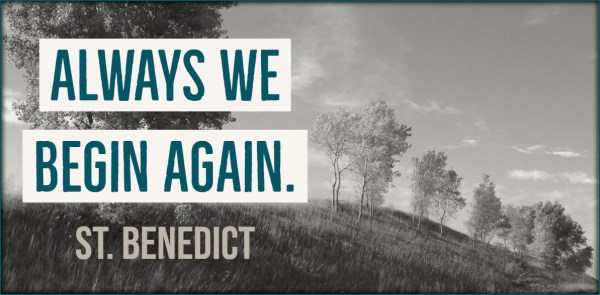
To be SoulFully You, one must learn, in the lyrics of Red Molly, how to “hold it all”—to embrace the peaks and valleys of life. Yes, I want to hold it all, to be fully in this life. But then, to let it go—to not cling too tightly. To hold and let go is to embrace the paradox of what it means to live soulfully, to live the dance of life with grace, to honor both the beauty and the heartbreak, the beginnings and endings, knowing that to be SoulFully You is to always begin again.
If we are to live our lives fully and well, we must learn to embrace the opposites, to live in a creative tension between our limits and our potentials…we must trust and use our gifts in ways that fulfill the potentials God gave us.
Parker Palmer, Let Your Life Speak
“There’s a ‘time to weep and a time to laugh; a time to mourn and a time to dance’ (Eccles. 3:4). But what I want to tell you is that these times are connected. Mourning and dancing are part of the same movement of grace. Somehow, in the midst of your tears, a gift of life is given. Somehow, in the midst of your mourning, the first steps of the dance take place. The cries that well up from your losses belong to the song of praise. Those who cannot grieve cannot be joyful. Those who have not been sad cannot be glad. Quite often, right in the midst of your crying, your smile comes through your tears. And while you are in mourning, you already are working on the choreography of your dance.” -Henri Nouwen
To be SoulFully You is to live prayerfully, joyfully, playfully, gratefully, mindfully, and soulfully. I want to hold it all fully—the bittersweet moments and the sweet surprises. This year I stand at a threshold, a turning from one chapter of life to another, from working as a high school teacher to having more time to work on SoulFully You projects—planning and leading retreats, writing more, pursuing creative ventures, and sharing the joy of living fully.
The fullness of joy is to behold God in everything. –Julian of Norwich
So it seems there’s no escape | We are part beauty and part heartbreak|But I want to hold it all |To hold it all | Help me hold it all | God I don’t know what you want from this life | But I’m tryin’
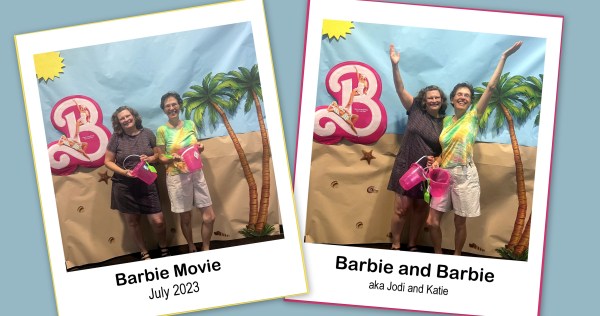
Barbie is a big deal. The smash-hit movie “Barbie” has reached the coveted billion-dollar mark at the global box office and its director, Greta Gerwig, had the highest-grossing opening weekend ever for a film directed by a woman. Millions of women—from 20-something to 70-something—have donned pink attire with their besties or their daughters—and headed to the theatres for pre-movie selfies and a trip down memory lane.
Barbie is a big deal. And, yes, even some guys have gone to the movie and enjoyed it! Every major newspaper, magazine, and news organization has weighed in on a variety of Barbie themes from feminism, patriarchy, and consumerism to mother-daughter relationships, authenticity, and existentialism. Since I saw Barbie with one of my besties, Katie, a few weeks ago, I have read dozens of commentaries on the film. One’s reaction to the movie, or, for that matter, any cultural, social, or political phenomenon, cannot be separated from our own interests, values, biases, and experiences.
My experience includes fond memories of playing with my Barbie dolls–selecting special clothes my parents told me Mrs. Clause had personally tailored, organizing my wardrobe suitcase, and setting up camp with a Barbie drive-camper. My daughter celebrated a Barbie-themed birthday, loved her Pepto-Bismol pink bedroom with Barbie comforter and curtains, and had all the Barbie things, even a lunchbox. Barbie captured the imaginations of little girls, and when they became mothers, their little girls enjoyed them as well.
“We mothers stand still so our daughters can look back to see how far they have come,” the spirit of Handler, the inventor of Barbie, said to Barbie, played by Margot Robbie, in the film.
I absolutely loved the movie--from the set and costume design (I mean, a life-sized Barbie house!), the special effects, the song selections and dancing, the clever comedy/satire, the Birkenstocks and the many feminist themes that elevated the movie to one for serious discussion. Katie, and I shared laughs and tears, many de-briefing conversations, and a commitment to see the movie again. My one wish–that I can also see it with my daughter someday.
But, this is what I have been considering: What are the spiritual lessons we can learn from Barbie?Is Barbie being Benedictine? Yes! I see a few themes in the Barbie movie that provide a glimpse of what it means to be Benedictine.
Barbie considers her death.
Early in the movie, Barbie asks her friends, “Do you guys ever think about dying?” This existential question is the impetus for Barbie’s (s)hero’s journey, one of curiosity, self-discovery, and transformation, depicted in religious literature, myths, and poetry since the beginning of storytelling. When Barbie’s perfect plastic curves are met with the disappointment of flat feet, cellulite, and clumsy accidents, she attempts to restore the status quo. She experiences a “dark night of the soul,” desperate only for life to go back to the way it was (as she lies face down, in humility, pining for untroubled times.)
When faced with our own mortality, we come face-to-face with the certain uncertainty of our lives. When Barbie adventures into the Real World, where events are not contrived, she is faced with the purpose and meaning of her life, eyes opened to embracing both joy and suffering, aging and death.
St. Benedict advises in his Rule, to “Keep death daily before your eyes.” These thoughts of death make Barbie more human, real, and authentic—once she realizes her own mortality, she cannot unsee it. Her old life has gone, and a new way must be birthed. Barbie is becoming.
Barbie listens.
In one of the most poignant scenes in the film, Barbie is overwhelmed by the stimuli of the Real World. She pauses to sit down on a bench to consider her next steps. This act of pausing to contemplate is the epitome of being Benedictine.
“Lord our God, hear my prayer, the prayer of my heart. Bless the largeness inside me, no matter how I fear it. Bless my reed pens and my inks. Bless the words I write. May they be beautiful in your sight. May they be visible to eyes not yet born. When I am dust, sing these words over my bones: she was a voice.”
Ana, The Book of Longings
In The Book of Longings by Sue Monk Kidd, Ana writes this prayer of longing on the incantation bowl her aunt Yaltha has gifted her. “Do you know what an incantation bowl is?” Yaltha asked. “In Alexandria we women pray with them. We write our most secret prayer inside them…Every day we sign the prayer. As we do, we turn the bowl in slow circles and the words wriggle to life and spin off toward heaven.”
It’s not just a cliche. Images are powerful. They conjure up feelings, memories, ideas. They tell stories. They stand for something.
A brandmark or logo expresses the identity of a business that is easily recognized without using words. Businesses spend a ton of money developing their brand identity, not that we need the business world’s affirmation of the power of images. We already know it. We know it in our soul.
I started this website, SoulFully You, in 2014 to share information about my passion for SoulCollage® and retreats that I planned to offer. SoulFully You is about living soulfully, practicing one’s spirituality through SoulCollage®and other contemplative and creative expressions.
In 2016, I started a website called Being Benedictine, to share reflections about what it means to live as a monk in the world, following the Rule of St. Benedict as an oblate.At first, these two blogs seemed separate and distinct.
But as I have continued to write, create, and reflect, I have realized that listening to the Divine is integral to BOTH living soulfully and to being a Benedictine oblate.
There isn’t a line of separation between living creatively and listening to God.
They are one and the same. A listening heart is the foundation of creative, prayerful spiritual practice like SoulCollage® AND to being Benedictine–promising obedience, stability, and conversion of life–as an oblate.
For this reason, my 2020 vision is to slowly migrate SoulFully You blog posts also to Being Benedictine under the menu heading, Visio Divina~SoulCollage®, where one can find information about SoulFully You retreats, the practice of Visio Divina (listening to God through art and images, including SoulCollage®) and blog posts specifically about using art, images, and SoulCollage® to grow spiritually. You can sign up for email notifications or follow Being Benedictine on Word Press reader just as you have for SoulFully You.
Below is a sampling of posts on celebrating Earth Day using SoulCollage®.
I created a SoulCollage® card for my daughter when she was 21 and going through what some Millennial research experts dubbed a “quarter-life crisis.” At that point in her life she was going through the oh-my-gosh-where-did-the last three-years-of-college-go-?-I-still-don’t-know-what-I-want-to-be-when-I-grow-up-and-there’s-only-one-year-left-of-college-until-the-real-world-hits-me-upside-the- head and-my-parents-declare-my-financial-emancipation!
Fast forward four years, and she reaches another crossroads. Of course, wise mothers know that these crossroads are the markers of a life well-lived. Life is full of forks in the road and sometimes a few detours. There is never a straight road with easy answers about which direction to go. We come to accept that normal is the in-between spaces of what was and what is to come, while we practice trust, patience, and big listening, an opportunity for Life Lectio.
It was during this time of in-between, the summer of her quarter-life crisis, that I created a SoulCollage® card for Jessica’s 21st birthday. It represented my advice/prayer for her. I hoped it would be an image for her to practice Visio Divina, deep and big listening to her intuition. I share again the image and words of Just Listen: Continue reading “Just Listen: Big decisions require big listening”→
The most used words in marketing campaigns and on product packaging are new and improved. This expression taps into our deepest desires to improve our lives and our circumstances. Marketers know this—that most of us want better and that we want to BE better, to be more of this or less of that—and so come the advertisements for weight loss, exercise facilities, home improvement, travel and more. Of course, the superficial and material never satisfy and leave us still wanting more, or less.
The essence of making New Year’s resolutions—everything from setting financial, career and relationship goals to considering new ways of being and doing—is that we desperately seek the chance to “do over.” It might sound elementary, and even impossible, but we long for it anyway.
Celebrating the beginning of a new year is a reminder of our opportunity to “always begin again”—the embodiment of Being Benedictine. It’s not as simple as a “do over” but January 1, merely just one day that follows December 31, gives us a definitive time and space to honor our deepest longing to begin again.
I’ve long since quit making resolutions. Well, not really—I make them and break them so quickly and consistently, that I’ve chosen to look at them more gently, as beginning again. Each year I select a word that will help guide me in the New Year.
I share my last three years of words that have served me far beyond the year they were chosen for—mercy, gentle and cushion. The intention of these simple words has seeped into my spirit in a way that makes me new and improved in the deepest sense.
What powerful images Pope Francis brought to this word when he declared a Jubilee Year of Mercy in 2016 and captured in a SoulCollage® card that I made to remember that year. We are received just as the Prodigal Son was received, with open and forgiving arms. The image of the Prodigal Son conveys all of the qualities of mercy that we hope to receive and strive to give: compassion, tenderness, love, and acceptance. In our thoughts, words, and actions, towards ourselves and others, we have a new day to try again to give and receive the mercy that God has given us. We are not perfect; we need to forgive ourselves and others again and again, but the doors are always open for us to begin again in light of Christ. Read more at Always, We Begin Again.
There is an endless list of shoulds, musts, shouldn’ts, can’ts, more of this or less of that, that could be the foundation of a New Year’s resolution. But for 2017, I resolved not to resolve anything but to be excessively gentle with myself instead.Resolve, itself, is such a dogged, unwavering word, so I called this “being gentle” my un-resolution. In a series of SoulCollage® reflections, I asked myself—How can I learn to be more gentle with myself and others? This process was so revealing and healing. I learned through images that I don’t have to “wear” everything I’m given. Perhaps the old and worn, even the cherished, can be hung up for a while; not discarded, but set aside. One cannot keep wearing what is from the past; sometimes we just need to hang it up, to let it rest. Our shadow side can be carried in the heart as shame unless we practice being excessively gentle. Read more at Be Excessively Gentle: A New Year’s Un-Resolution.
Perhaps, a funny word next to the more sober “mercy”, but I chose the word cushion for 2018 to represent balance, an invaluable tool of Benedictine spirituality. When seeking a balance between the seemingly opposite speaking and silence, being together and alone, between activity and rest, prayer and work, I consider how to create a cushion. The connection between these two good options is the word “and”, not “or”. We need both. We need balance, yes, but we can give ourselves a cushion, the opportunity to rest knowing that perfection is not expected. We listen. We act. We pray. We readjust. “This is how a Benedictine’s day is. It is always changing, alternating—praying, working, resting. This is captured in the Benedictine motto, pray and work…The most important word is ‘and’.” –Fr. Mauritius WildeRead more at 2018 Word of the Year…drumroll, please.
Cushion SoulCollage Card–Word for 2018
There is nothing magical about these words and there is no guarantee that one or any other will be the secret to creating a new and improved you, but I have found this process of choosing a word to be integral to my journey of seeking God, peace, and joy in a world of uncertainty.
May your New Year bring you the mercy, cushion and excessive gentleness that you need. As you journey through the joys and inevitable sorrows of the next year may you find meaning in the words of John O’Donohue— “At first your thinking will darken / And sadness take over like listless weather. The flow of unwept tears will frighten you. / You have traveled too fast over false ground; Now your soul has come to take you back…Draw alongside the silence of stone until its calmness can claim you. Be excessively gentle with yourself.” –an excerpt from “A Blessing for One Who is Exhausted”
What word resonates with you? Will you pick a word for 2019? Consider creating an image that captures the essence of your word. Please share your word or image in comments!
For 2019, I have selected not just one word, but a phrase instead. “You are free” is a phrase given to me that I’ve been meditating on and practicing with for several months. It has seeped into my being and doing just like my other words. I’ve created a collage that captures what freedom might feel like. I will share more soon!
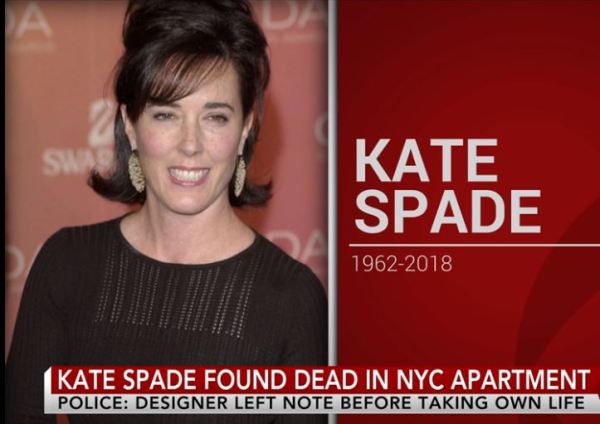
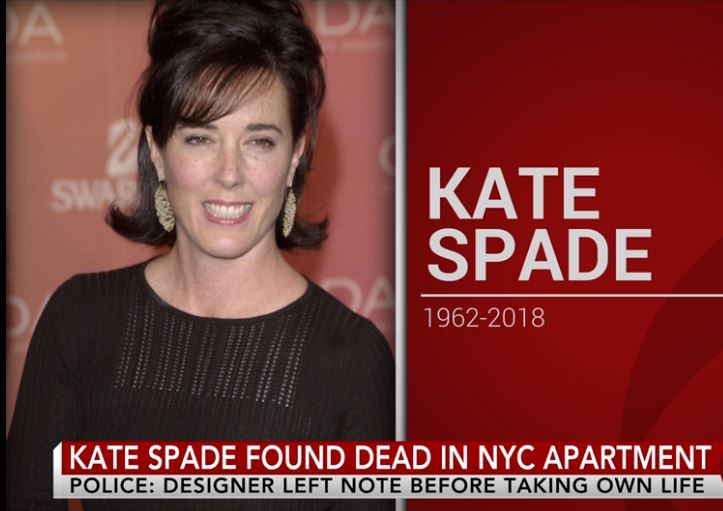
I don’t know Kate Spade. I don’t own any of her purses or other products. I’m not fashion-conscious by any stretch of the imagination—my daughter/personal shopper will vouch for that. But the news that Kate Spade—a beautiful, wealthy, creative woman—has ended her life has me in tears.
There are many unanswered questions for those left behind when someone takes their own life. I wonder about this woman I do not know. Were there demons in her head that told her she wasn’t enough, that there was no hope for healing her pain, that she was a burden to those who love her? I wonder about her husband, her child and her close friends. I wonder if she reached out for help. I wonder why her love for her daughter seems not to have been enough to override her feelings of despair. So many questions…
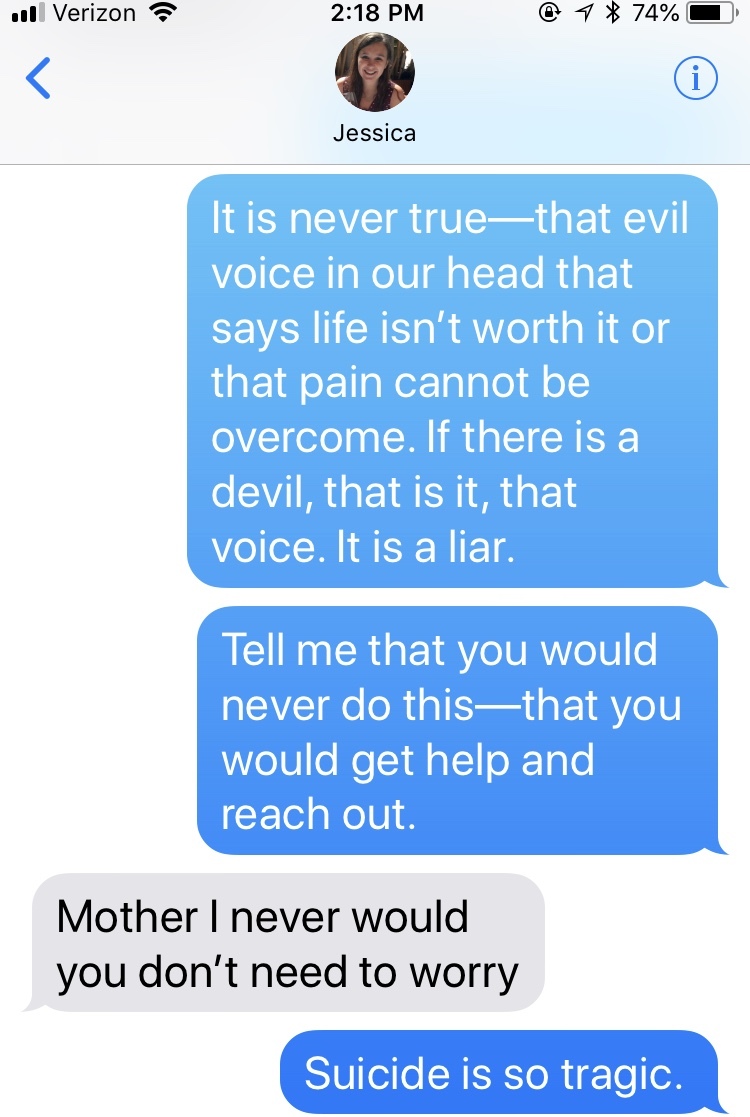
I immediately reached out to my own daughter—“If you ever ever ever feel that kind of depression or desperation, please please please reach out…It is never true—that evil voice in our head that says life isn’t worth it or that pain cannot be overcome. If there is a devil, that is it, that voice. It is a liar.” I thought of a former student who loved Kate Spade and her products—I sent her a message too. “This is shocking news but a testament that no one is immune.”
So often we think that the rich and famous, or educated, funny, spiritual (or any of the qualities we covet), do not struggle with depression and despair. But they are human, too. Even Kate Spade, who chose to end her life, must have felt she had no choice. There is a mystery to suicide. There is much we do not know or understand, but we should not blame those involved and/or think that it happens only to others.
We are all vulnerable. I lost a friend to suicide over a decade ago—and it still makes me sad and angry. I have also had bouts of depression, despair and the occasional voice of the devil that rears its ugly head in my thoughts. We are all vulnerable to becoming a victim of suicide—either one who is left behind, as one who struggles with despairing thoughts or the one who completes this final act.
In the weeks before my dear friend, Colleen, decided to take her own life, she suffered from immense physical, spiritual, psychological and emotional pain. No one can feel the pain of another or take it away but, still, I hope she received some comfort that she was met in her pain through conversations with and prayers from her loved ones.
I used to think this was enough—to be available and compassionate, to pray and forgive. But I think there is one more vital thing we can do for ourselves and others—tell them NOT to leave, beg them NOT to listen to the voice of the devil, the liar in their head.
And as you encounter someone who seems at risk of suicide, consider the advice from St. Benedict, “Let all guests who arrive be received like Christ” and treat each person as if they were Christ himself, particularly yourself. You are the Christ-bearer and worthy of patient waiting for the dark night of the soul to pass. For an excellent article and insight from a Catholic perspective, read A Catholic Approach to the Suicide Epidemic.
A few months after we had moved into our new home, one of my favorite monks, Fr. Thomas Leitner joined us for a special dinner and house blessing. After the introductory prayers and Scripture readings, Fr. Thomas sprinkled Holy Water that had been blessed at the Easter Vigil in each of our rooms—the living room, bedrooms, kitchen, upstairs, downstairs and even next door at Al and Beth’s house, our townhouse roofmates—and a little extra splash for our loyal Dachsy-Poo, Bailey. Our daughter, who was finishing her last year in college, would spend a few months living in our new home, but mostly it would become our empty nest. This blessing for our home was also a blessing for the next chapter in our lives.
Fr. Thomas also gave us a special gift, a replica of Andrei Rublev’s Holy Trinity Icon. An icon, an image or religious picture, communicates a deeper spiritual meaning often used in prayer and meditation for Christians throughout the world. It was a special image for him, used as the holy card for his ordination and First Mass in 1992.* He enthusiastically shared with us why he also felt it represented how we would welcome those who entered as guests and the hospitality we would extend in our new home.
The three angels in the icon symbolize the three strangers that Abraham welcomes into his tent in Genesis.
Abraham’s Visitors
The LORD appeared to Abraham by the oak of Mamre, as he sat in the entrance of his tent…he saw three men standing near him. When he saw them, he ran from the entrance of the tent to greet them …He ran to the herd, picked out a tender, choice calf, and gave it to a servant, who quickly prepared it. Then he got some curds and milk, as well as the calf that had been prepared, and set these before them, waiting on them under the tree while they ate (Genesis 18:1–8).
The three angels wear different colored garments representing their distinct role in the relationship of the Trinity. Viewed left to right, the angels represent the Father, Son, and Holy Spirit. “The first angel wears a blue undergarment, symbolizing the divine nature of God and a purple outer garment, pointing to the Father’s kingship. The second angel is the most familiar as he is wearing the clothes typically worn by Jesus…The crimson color symbolizes Christ’s humanity, while the blue is indicative of his divinity. The oak tree behind the angel reminds us of the tree of life in the Garden of Eden as well as the cross upon which Christ saved the world from the sin of Adam. The third angel is wearing a blue garment (divinity), as well as a green vestment over the top. The color green points to the earth and the Holy Spirit’s mission of renewal…The two angels on the right of the icon have a slightly bowed head toward the other, illustrating the fact that the Son and Spirit come from the Father.” (Source: The Russian Icon that Reveals the Mystery of the Trinity, Alteteia, Philip Kosloski, May 21, 2016)
A chalice sits at the center of the table representing both the literal meal the strangers were invited to and the table of the Eucharist we are invited to. It appears the Holy Spirit points towards an open space at the table, perhaps as an invitation to each of us, to all, to sit at the table—to be welcomed and received as Christ.
“At the front of the table, there appears to be a little rectangular hole. Most people pass right over it, but some art historians believe the remaining glue on the original icon indicates that there was perhaps once a mirror glued to the front of the table. It’s stunning when you think about it—there was room at this table for a fourth. The observer. You!” (Source: Take Your Place at the Table, Tuesday, September 13, 2016, Richard Rohr)
Fr. Thomas’ gift was a perfect expression of what Joe and I desire our home to be—hospitable and welcoming. Ironically, or providentially, a nail hung on an empty wall near where we opened our gift, so I placed the icon on it. It is the perfect place for it—in our living room where friends and family gather, and at the entry to our kitchen where most entertaining takes place.
Holy Trinity Sunday is celebrated in many churches this weekend. It is an opportunity to remember, “…this Table is not reserved exclusively for the Three, nor is the divine circle a closed circle: we’re all invited in.” (Source: The Divine Dance: The Trinity and Your Transformation, Richard Rohr with Mike Morrell)
St. Benedict insisted that hospitality be one of the highest values for monasteries, writing “Let all guests who arrive be received as Christ.” (RB 53:1) Being hospitable is our opportunity to respond to God’s great generosity towards us. If we are truly made in God’s image, lovingly invited to the Table and to dance with the Holy Trinity, then we are meant to extend that welcoming invitation to others.
*A note from Fr. Thomas: This icon, which is used to depict the Holy Trinity, originally was meant to show the three Divine visitors to Abraham (Gen 18:1-15). The day of my First Mass in Noerdlingen was the 16th Sunday of Ordinary Time, Year C. On this day, Gen 18:1-10a is in the Lectionary in conjunction with Luke 10:38-42, Mary and Martha. The topic of hospitality, that we find as we combine these texts lent itself so well for the homily (preached by my former novice master, Fr. Meinrad) and also for my little speech at the reception. We practice hospitality and, perhaps without being aware of it, receive God in the guest.








 SoulFully You