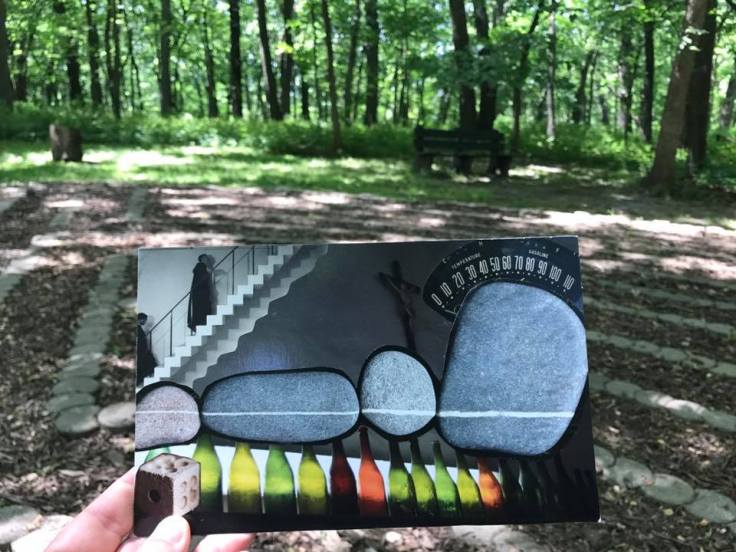
Rome: Confessions, Truths and Carpe Diem!

Confession: I feel a little guilty for taking nine days off during the school year.

Truth: But not enough that I wouldn’t seize this once-in-a-lifetime opportunity to travel to Rome.

It’s unheard of for a teacher to take off two weeks during the school year. First, we only get eleven days off for sick or vacations days per school year. Second and more importantly, it’s a lot of work to be gone, planning what students will do, securing a trusted substitute teacher to deliver curriculum, and “letting go” of controlling my classroom. (Perhaps this has something to do with being a bit of a perfectionist, control-freak, as I’m learning about Enneagram, Type One.)  Usually, teachers take time off for a wedding or funeral, a child starting college, an important doctor’s appointment, but a two-week long trip? Nope.

After reviewing my teaching contract, I knew I didn’t need formal permission to take the nine days off in a row, but it was important to me that I have my principal’s blessing because it can be just as difficult for students when teachers are absent. But, Principal Brent Toalson was so gracious in understanding my unique request to take time off. He agreed with what I strongly believe: life is short and it’s important to seize the day when opportunities come.

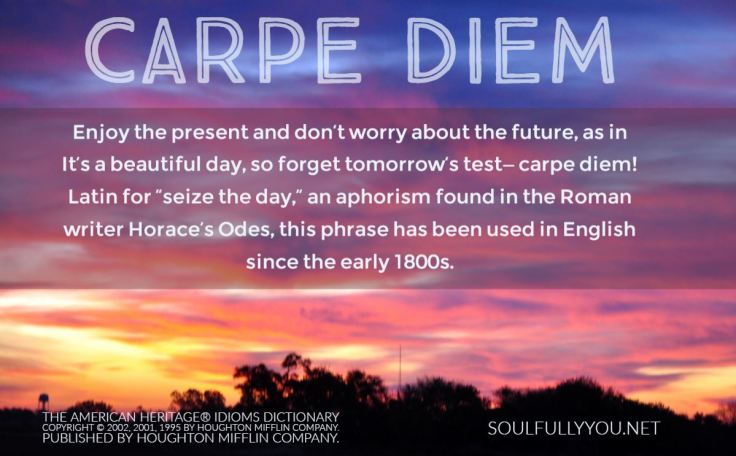
carpe diem

Confession: I’m a little nervous about leaving my classroom for two weeks.

Truth: I have no reason to feel nervous because I have an amazing substitute teacher, Karen Kay, a retired business teacher and my former department chair, who will step in and do everything perfectly (I think she’s probably an Enneagram One, too.)  When my mother-in-law passed away two years ago at the beginning of the school year, Karen taught the first week of classes for me. It was the best start of a school year my students ever had!

So CARPE DIEM!! I’m off to Rome to attend the Fourth International Congress for Benedictine Oblates. The conference is hosted every four years for Benedictine oblates, novices and oblate directors from around the world.

Oblates are ordinary people who want to live as a monk in the world. Affiliated with a specific monastery (for me, that is Christ the King Priory in Schuyler, Nebraska), oblates strive to become holy in their everyday life, in their family and their workplace. Oblates promise to live a prayerful life according to the Rule of St. Benedict. I write about being an oblate at Being Benedictine.

being ben

The Congress theme, A Way Forward – The Benedictine Community in Movement, will provide encouragement for oblates to be peacemakers in a broken world, sharing hospitality in the face of war, terrorism, refugee crises and religious fanaticism, and to be stewards of an abused planet as challenged and inspired by Pope Francis in his encyclical “Laudato Si”. Surrounded by chaos, idolized entertainment, digital noise, and consumerism, oblates desire a life of silence, contemplation, and simplicity.  We hope to answer the question: How can we as oblates create and contribute to communities around us – in our oblate groups and chapters, in our families and neighborhoods, in our workplaces, in our own monasteries of oblation and in society as a whole?

Oblates desire to be change agents in their own communities – together finding a new way forward. It sounds like a daunting task, a tall order, and very serious business. But as an oblate, I have hope that each of us can do our part to encourage peace.

A few things I look forward to:

  • Meeting and hearing Keynote Speaker, Sister Joan Chittister, OSB aka my (s)hero! Joan is one of the best known international speakers on Benedictine spirituality and social justice in the world. Author of over 50 books, Sr. Joan has been a courageous and sometimes controversial advocate of social justice, especially for women, in both church and society. She founded Benetvision, a web-based movement sharing Benedictine spirituality and currently co-chairs the United Nations-sponsored Global Peace Initiative of Women. More info about Joan Chittister HERE.
  • Spending time with my spiritual director and friend, Father Mauritius Wilde, who moved to Rome a year ago to serve as Prior of Sant Anselmo Abbey. I’m excited to see where he lives and works, to walk the streets of Rome together, to sneak in a spiritual direction session and to just be in the presence of a special friend. Fr. Mauritius writes a blog and has over thirty podcasts on Benedictine spirituality.
  • Visiting historic and religious sites including the Vatican, St. Peter’s Basilica and the necropolis on a Scavi tour, St. Benedict’s cell at San Benedetto and the Abbey he founded at Montecassino and attending a General Audience with Pope Francis (I harbor a secret desire of a drop-in visit by him at the conference. I will secure selfie evidence if my dream comes true.)

Confession: I plan to post updates while in Rome, making a conscious effort to let go of some perfectionist tendencies I have of editing, re-editing, and rewriting. Another confession: I have a few dozen blog posts sitting in a folder waiting for the perfect touches. I take solace in the fact that there are few sleepless nights for those wondering when I will publish my next post.) I surrender the notion that any of my blogs are perfect anyway.

Truth: I plan to live in the present moment, seizing opportunities, meeting new friends and enjoying many new experiences. Carpe diem! 

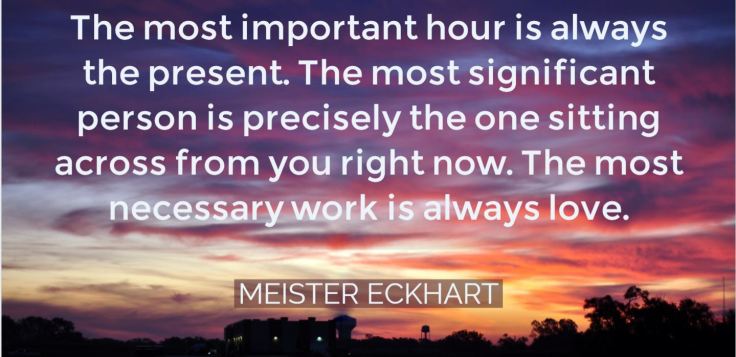
present moment 2

Yes and No: The Seasons of Life

“Are you doing okay?” a friend asked me.

“Yes and no, ha,” an honest reply.

 “Why yes?”

Hmmm, I think.  “Good question…yes, because of faith and hope. Many blessings.”

This might not be the typical are-you-okay-what’s-wrong? line of questioning one might expect, but good friends know what’s behind your “yes and no” already.  Sometimes the no just needs to lie right where it is; it’s the yes that needs more attention.

21616232_10214007330207686_1585915307798533116_n

Likely, the question was meant for me to consider what is good? what is hopeful? what is well with my soul? 

A few days ago, I created a SoulCollage® card, that I named “The Seasons of Life: I’ve Seen A Lot of Shit.”  Eloquent, I know, but it’s the first thing that came to mind when I looked at my finished card.

seasons of life1I had no idea what I was creating when I started, with no goal in mind. I was drawn to the older women sharing stories and enjoying each other’s company.  They look experienced (not old, please), rested, peaceful, connected, comfortable and wise. I imagined what it was they might be discussing. Perhaps the storms of life, the many changes they had experienced, their efforts to rise or reach or resist, obstacles they had overcome, obstacles that made them feel all shot-up and yet, in the end, still standing, still sitting, still connecting, still enjoying.

Both women hold a little of each season, every year, and the many experiences they have lived within them.

“Autumn holds fragments of the other seasons in transformative arms…the mood of autumn is the ebb and flow of life. Autumn stands as an epiphany to the truth that all things are passing and even in the passing there is beauty. It holds out platters of death and life.” -The Circle of Life, Joyce Rupp & Macrina WiederkehrDSC_0267a

Each of us is called to take the seasons of life into “transformative arms”, to become more of who we are. So this autumn weekend, I consider the seasons of life—all of it, especially the blessings. I think about the “yes” of life that threads itself through my days—the yes to faith, hope and gratitude for many blessings. The daily yeses keep me focused on the bigger yes—the yes to God.

My yes is the desire to become more of who God created me to be.  This I have hope for and believe in. This I am grateful for and what I say yes to.

Yes, it is well with my soul.

 “People often speak of becoming more grateful after having lost some of their health. Suddenly they see all they have taken for granted. Gratitude for all that has been enables them to say yes to all that is to come.” -The Circle of Life, Joyce Rupp & Macrina Wiederkehr

DSC_0383a

I Pledge Allegiance to the Flag…despite my disappointment

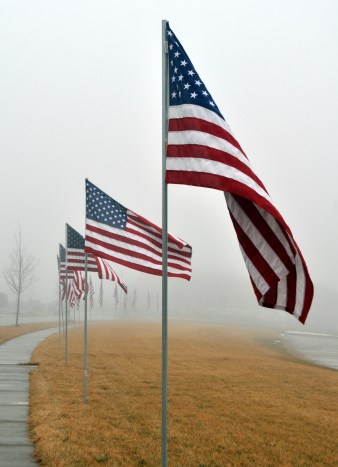
Each school day during my 3rd-period Marketing class, I stand with my students, hand over heart, pledging allegiance to the Flag of the United States of America and to the Republic for which it stands, one Nation under God, indivisible, with liberty and justice for all. 

This simple moment of national patriotism is a requirement in Nebraska, a rule passed by the Nebraska Board of Education in 2012  stating that all public schools must provide time every day to recite the Pledge of Allegiance in order to receive accreditation or state funding. Already a common practice in elementary schools and many districts, it was a new practice for most high school students.702848[1]

After the rule passed, teachers took an inventory of classrooms that needed flags—many were old and torn, more had been discarded over the years and with tight budgets, new ones hadn’t been purchased. The first several weeks, hand over heart, we stood facing an 8 ½ x 11 colored photocopy of the flag until a generous alumni donated enough American flags for every classroom.

Reciting the pledge is voluntary for students and teachers. We can recite the pledge either standing or sitting or remain quiet showing respect for those who do participate. After five years, I am still surprised when there are a few students that don’t stand to say the pledge. I’ve wondered why. This semester every student stands. DSC_0874a.JPG

Regardless of our different political views or opinions, it feels like the one great gesture we can make together is agreeing to pledge allegiance to the flag. We have so many other opportunities, especially this past year, to take a stand (or sit), to disagree, to voice an opinion, to protest or resist. But I’ve also come to the conclusion, and I respect, that not everyone feels the same and that perhaps they have good reasons for not standing or reciting the pledge (besides it’s their constitutional right). In the words of Pope Francis, who am I to judge?

For a few years, I showed a short video clip with Red Skelton explaining what each line of the Pledge meant to him (if you are old enough to know who he is, likely you stand without question for the Pledge of Allegiance).  Maybe I’m old-fashioned, but I will continue to stand in spite of my disappointment, even shame, at what has become of our United States. I have faith in the words of our Pledge and faith in the meaning behind the words.

As I say the Pledge, I take the time to breathe, slow down and really think about the words I’m saying. I hope and pray that my country will live up to the words that each day we profess. There are far too many days lately when I’m uncertain what America really stands for, but when I say the words of the Pledge of Allegiance, it is this in which I believe:

I PLEDGE ALLEGIANCE, promising to speak my truth while remaining committed, TO THE FLAG  as a symbol OF THE UNITED STATES OF AMERICA.  I pray, even when we seem so divided, that we are united in, and take seriously, our responsibility to all people within and beyond our borders, especially those who flee their own country seeking a place of peace and promise.  I hope we are not so proud of our country that we forget about others, that our desire for unity does not become exclusion.

AND TO THE REPUBLIC FOR WHICH IT STANDS, a country that is a worthy and wonderful place to live, grow and be, representing a land of opportunity and a chance to always begin again. 

ONE NATION that represents a diversity of opinions, beliefs, ethnicities, lifestyles, socioeconomic and educational groups, yet a nation that comes together and is unified in times of tragedy and trial;

UNDER GOD, through our faith, hope, and prayer, in the spirit of our founding fathers and mothers, guided by a morality that resides within;

INDIVISIBLE, without division, united with wholeheartedness of spirit;

WITH LIBERTY AND JUSTICE, in gratitude for our freedom, with a duty to be fair and honest, and respectful of all we encounter.

FOR ALL.  In God’s eyes, there are no borders—we breathe the same air as the refugee, immigrant, gay, straight or transgendered, Muslim, Hindu or Christian, Republican or Democrat, liberal or conservative, Protestant or Catholic. We breathe the same air as those we disagree with and those we live with. We are one world. Oceans cannot be divided, this part belonging to Europe and that part belonging to America. The air cannot be split—Mexico breathing this air and America breathing that. No, we breathe the same air. We are connected to all people, all countries. All means all.

This I pledge. This I stand up for. This I place hand over heart for and recite every day of the school year. This I pray.

Our words matter, so how can we live what we profess and believe, as individuals and as a country? Each of us must reflect on what it is that we place hand over heart and stand up for.

DSC_0872a

“I pledge allegiance to the Flag of the United States of America, and to the Republic for which it stands, one Nation under God, indivisible, with liberty and justice for all.”

Marriage Moments: 32 years and counting!

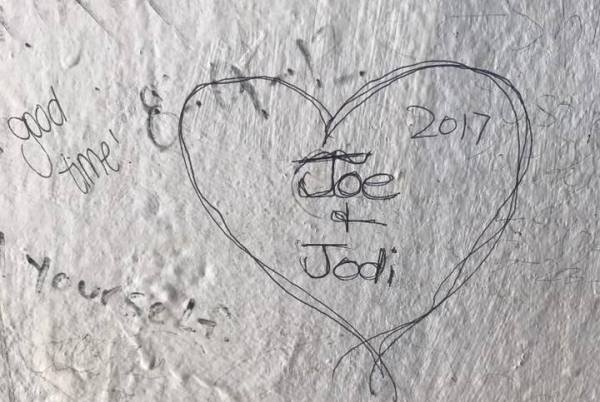
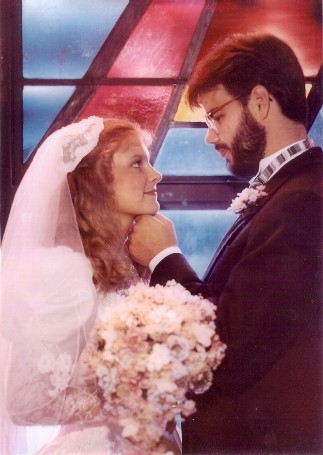
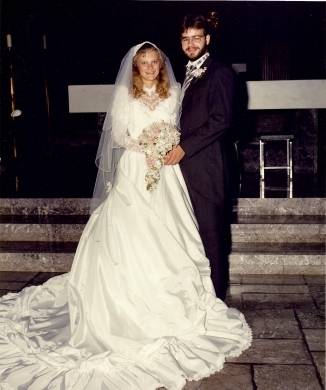
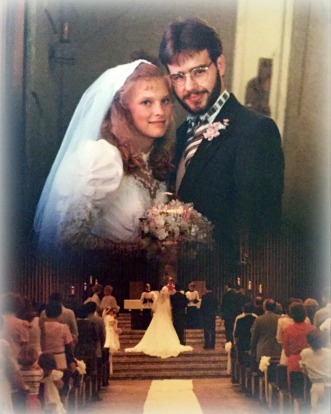
Jodi Blazek ❤ Joseph Gehr, August 17, 1985scan0009

A marriage is made of moments. When you string them all together, you get a picture of a life built together. A marriage isn’t made, once and for all, when the I-dos are exchanged. A marriage is constantly being recreated; it is always in the process of becoming.

A marriage goes through seasons: the spring of new life and hope, the summer of comfort and security, the autumn of changes and letting go, the winter of sadness and despair. A marriage will not survive without adapting to, enduring and celebrating the change of seasons. A marriage embraces all seasons.

I believe more each day that it is only in the stability of marriage, enduring the weather of every season, that one can reap the true benefits of a life lived together. Advice to young couples: Stick with it. Don’t give up.  I promise, with effort, love, respect, and forgiveness, your marriage will endure and you will be so happy it did!

A marriage is made of moments.

scan0008Marriage includes the necessary and mundane—doing laundry, taking out the trash, paying bills, fixing, washing, mowing, checking things off the list of things to do, arguing about checking things off, thanking each other for checking things off.

After 32 years of marriage, Joe and I have so many “remember when” moments, the makings of great storytelling or one-liners that no one else understands but us. Funny, sad, silly, stupid, poignant, heartwarming, memorable moments. Moments we’d like to forget and moments we have to forgive. But, mostly, moments that have helped us become who we are.

A marriage is made of moments. Some of our earlier moments:

  • Joe sending little gifts to me for several days before our wedding that said: “7 days til a lifetime” (6, 5, 4 and so on). Each day a new gift arrived.
  • Working four jobs between us so I could finish college, sometimes with only enough time to exchange notes or take a break together at one of our shared part-time jobs at Montgomery Ward.
  • Buying our first home and meeting our neighbors, Cece and Bob. Cece, who became a widow just six months later, became part of our family and a grandma to our daughter.
  • Having our first baby and Joe announcing “You got your girl!”, when she was born…my secret hope.
  • Experiencing the loss of two babies and the grief of infertility while creating a family of three with more love than we could imagine.
  • Welcoming dogs (Ralph, Rosie, and Bailey) and cats (Peaches and Boots) into our little family…and missing their love and companionship when they passed on.
  • Being parents to Jessica, from diapers and bottles, soccer games and DECA competitions to college internships and sorority activities.
    wedding

A marriage is made of moments. Our life now:

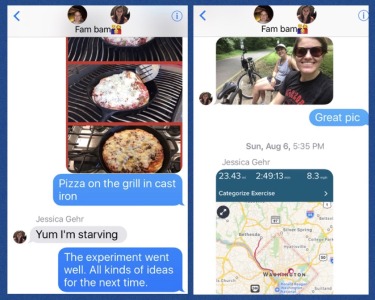
  • Being empty nest parents to Jessica, staying in touch with our daily Fam-bam texts.  Everything from biking routes that Jessica and a friend took to pizza Joe and I made in a cast-iron skillet to a virtual shoulder to cry on during some rough patches. We are a family connected wherever we are. FullSizeRender (49)
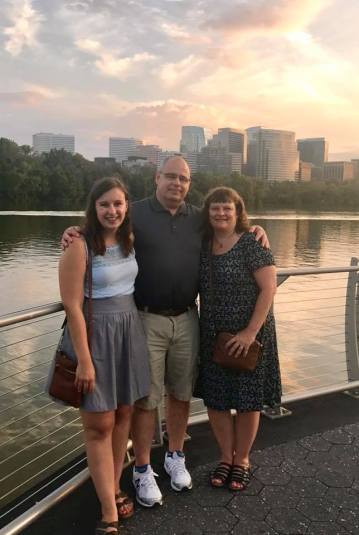
  • Visiting Jessica at her home in Washington DC, letting her host us and be our tour guide. (Of course, we still pick up the check at all the restaurants she has been dying to visit.)20292910_10213492358253709_6210654865780852683_n
  • Enjoying what still feels like our new home, getting into jammies the minute we get home from work, making dinner, yelling at the news (rather than at each other) and thanking God that we have grown together, sharing the same world view in very troubled times.
  • Providing comfort, support and unconditional love for each other (and Jessica) during some very challenging and painful experiences this past year.

    20663676_10213608103347264_2563520287176871971_n
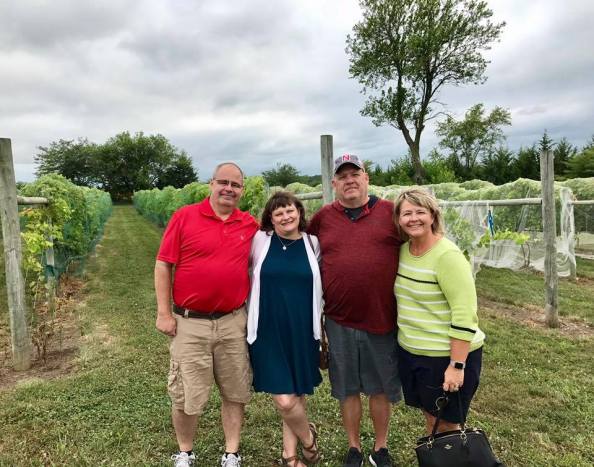
    With the Schoenings, friends we met Jessica’s kindergarten year. Just like family!
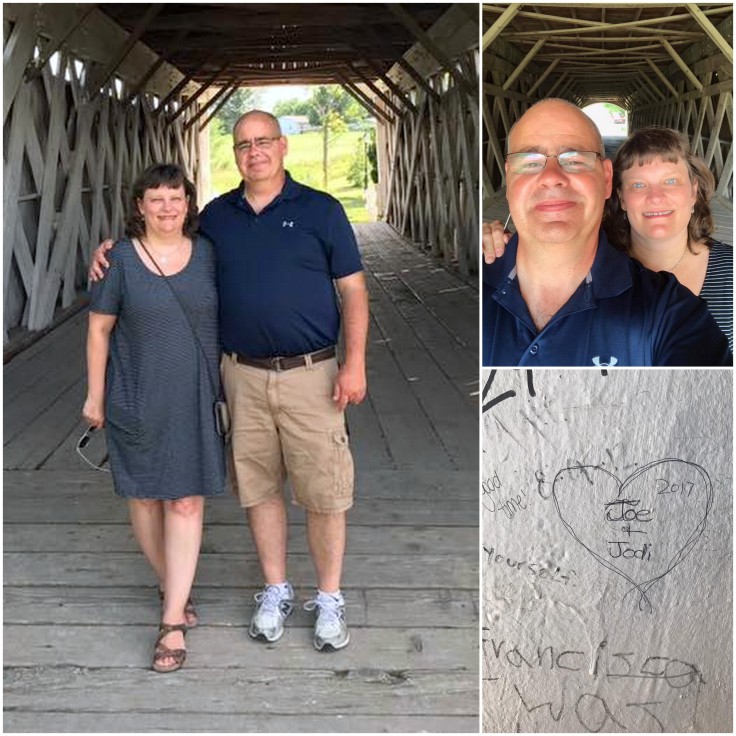
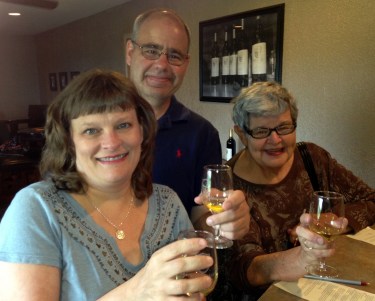
  • Becoming more adventurous as empty nest parents: enjoying fun times with friends, day trips to nearby wineries, and taking a special trip to the Bridges of Madison County just the two of us.

Desktop12

Thirty-two years of marriage is a threading of memories, a string of moments that hold the seasons of life.  After 32 years, marriage is about acceptance. We rest into acceptance of who the other is, rather than attempting to create the other into who we would like them to be. We enjoy each other with a lightheartedness that wasn’t possible in the newlywed years. Time is funny: it goes too fast, but it also unfolds so slowly that we don’t always see the transformation of the innocent into the mature, the immature into the confident. After 32 years, I know that this man is someone I can count on no matter what the season. I am so grateful for our marriage and our beautiful grown-up girl!

Happy 32nd Anniversary to us!

A Marriage Made of Moments is a blog post I wrote for our 30th anniversary in 2015. For our 31-derful anniversary, I shared a revised post with updated photos, new “moments” and fresh reflections. Check them out too. ❤

Lover of Life: Ode to Mary

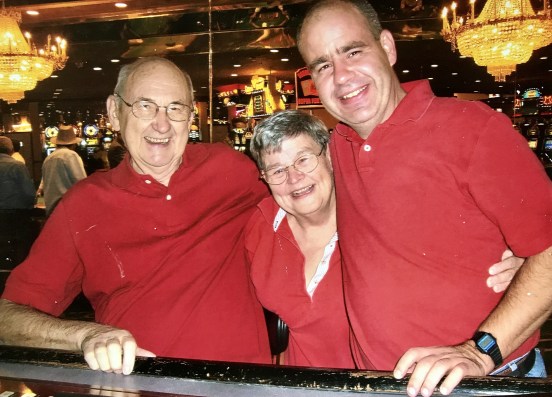
Mary Gehr, my mother-in-law, was a lover of life and laughing, parties and planning them.  She loved going to Las Vegas, playing video poker, Bridge, and Words with Friends. She loved Budweiser, murder mysteries, giving hugs, eating great food, cooking for others, Thanksgiving Day, and being with family.

Gehrs.jpg

Mary Gehr was a strong woman, an amazing mother, the rock of her family, the epitome of hospitality,  a peacekeeper, devoted wife, and bad-ass grandma.  She was spirited, full of joy, selfless, generous beyond measure, supportive, spontaneous, positive and funny. She welcomed everyone as family, would talk to anyone, was so darn lucky in video poker and keno and never worried about what others thought of her. She had dimples and a smile that lit up every room she entered.

17523_10201253028158106_1030445452_n
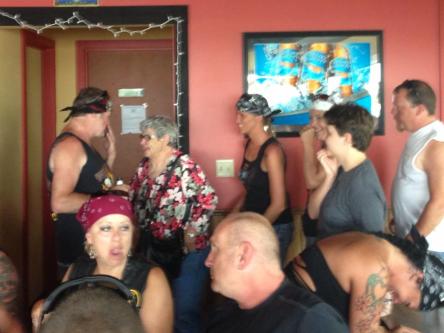
Mary made friends wherever she went. Here, she’s getting to know some bikers in a restroom line at Branched Oak restaurant.

We never know how long we have, life can change or end in a minute, but Mary Gehr was just as shocked as her friends and family that life took a turn for her on July 24, 2015, the day before her 78th birthday and the day of our daughter, Jessica’s 21st birthday. The last words she said before having a surgery to repair a perforated colon were, “I don’t want to die on Jessica’s birthday. I don’t want to die on my birthday.” She didn’t.  The few weeks she was kept alive on life support, she couldn’t talk, but she could nod her head and she could smile. When my husband asked Mary if she wanted to keep fighting, she nodded yes. She gave the fight of her life to stay with us. 

DSC_0354
Thanksgiving Day: Mary wears her “Nobody’s Bitch” apron

Mary had just started to live a new life of independence, finding her voice and making her own choices. It’s not that she didn’t have that with her husband, Marv, but she came into her own in a different sort of way after Marv passed. She was just as happy, even though she was sad. She was just as strong, even though she was lonely. She loved being around people, even though she could be alone. She got to know herself better and we got to know her in just a Mary-way, without Marv. She was a feisty lady and so proud of the name “bad-ass grandma” she earned from Jessica. 217477_10201067686839796_754692611_n

Jessica’s birthday party was Grandma’s idea. She loves a party–loves to host, loves to go, loves to have fun. But instead, she is lying in a hospital bed getting life support from a ventilator. After an eight-week stay alternating between the hospital and rehabilitation center, Mary’s colon perforated, poisoning her from the inside. Without emergency surgery, she would have died within hours. But surgery to remove most of her colon and repair damages left her weakened even more than before, fighting infections, kidney impairment, and many other critical issues.  Because Grandma Gehr loves to have fun, we went forward with the birthday party…and we had a blast. Our friends and family are so supportive, praying for Mary’s recovery but also celebrating with Jessica. *Written the weekend after Mary’s surgery and Jessica’s party.

Mary lived long enough to smile again, to hold a hand, to hear our good-byes. Mary died two years ago today on August 10, 2015.IMG_8620

My husband, Joe, summed up his mom’s zest for life in her eulogy: “One of our good friends offered sympathy at Marv’s funeral, gave Mary a hug and said, “You will be with Marv again.” Mary’s response: “I hope not too soon!” Rather than feeling sorry for herself, she took what life gave her and began to live every day like it was her last. She had so much fun and joy these last couple of years. Of course, she missed my dad, we all have. I think she cried a tear every day for him and every conversation we had, we talked about him in some way.”

Joe also shared these words about his mother, “We were taught the meaning of selflessness, caring, patience and compassion for humankind. We were taught to see people for who they were, not for who the world tells us they are. My mother’s arms were always open and welcoming to anyone, it didn’t matter who you were, where you came from or what you wanted, for my mom, it was about what she could do to help…IMG_8629Whenever you saw Mary, you would see a big smile on her face. It never mattered what kind of mood she was in; she was always happy to see you. If you didn’t want a hug, you were going to get one anyway. Sometimes I think she should have gone into politics. I think if she was the Secretary of State, a lot of countries would end their conflicts and hug each other instead. If you only met Mary for a few minutes, she would make an impression on you that would last a lifetime.” He closed with, “Couldn’t our country use a few more Mary Gehrs right now?”

The world could use a lot more Marys, but we were pretty darn happy to have our Mary. She was a one-of-a-kind-lover-of-life and it is with great joy we remember her today and always.


Luke vs. John: An 1800ish word paper

Last week I shared that I had read all four Gospels (God Does So Much And Asks So Little) and that I, despite procrastinating, was preparing to write an 1800-word paper responding to this prompt:  Explain the story of the life of Jesus as portrayed in the Gospel of John, and compare it to either Matthew or Luke and how this might relate to ministry today. 

A few of you asked to read the paper…and now that it is graded (94%), I feel confident enough to share the-just-shy-of-1800-words that I wrote.  I would love to hear what you think, whether you have ever read all four Gospels in their entirety, and what resonates most with your spirituality.

the wordJodi Gehr
Word Count: 1794

Each of the Gospels contributes to an understanding of who Jesus is. The Gospel of Luke shares Jesus as bringing a universal faith under the direction of the Spirit; John focuses on the power and divinity of Jesus to confer salvation and immortality (Harris 110, 189). The themes, characters, teachings and post-resurrection interpretations for each of the gospels support these unique aspects of Jesus. The relationship between John and Luke could be stated: the Johannine Jesus shows who God is while Luke shows people how to be God-like in their lives.

The Gospel of John, written between 90-100 CE, is a cosmic and theological, rather than historical, representation of Jesus (Harris 249-250). John portrays Jesus as the incarnation of divine Wisdom, born to overcome darkness, evil and chaos, bring light into the world and offer salvation (Brubacher, Jesus; Harris 250, 259). Exclusive to John, Jesus is revealed as the Word, or Logos translated in Greek, “When all things began, the Word already was. The Word dwelt with God, and what God was, the Word was. (John 1:1)” Jesus pre-existed, “In the beginning God created heaven and earth (Gen 1:1, Harris 259).” The Wisdom tradition united with Greek philosophy places Jesus existing, in cosmic order, at the beginning of the universe, cooperating with Yahweh before his incarnation (Harris 249, 259).

Greek and Jewish Wisdom literature, the hypothetical Signs Gospel, and oral teachings of the “Beloved Disciple” were sources that “John”, likely anonymous, used to reach a broad audience. Because of tension between Torah loyalists and Jesus followers, Christians were excluded from synagogues; for Christianity to be a sustainable religion, casting a wider evangelical net was imperative (Harris 250, 253). John also confronted the disappointment of Jesus’ original followers when an imminently predicted second-coming was not realized and to provide encouragement for believers who hoped a Messiah would save them from hardships (Brubacher, Jesus; Harris 250).

Ninety percent of John’s content is not in other gospels (Harris 113). Divided into two sections—the Book of Signs, seven miracles of Jesus; the Book of Glory, Jesus’ death as glorious, fulfillment of divine will, its Christology states Jesus and the Holy Spirit are one; after Jesus’ death and resurrection, the Holy Spirit takes his place (14:26). Jesus proclaims, “I am the bread of life (6:35), the good shepherd (10:11), the resurrection and the life (11:25), the way, the truth and the life (14:6, Harris 260-262).”  Jesus, with authority and “equality with God” gives a new commandment to love one another (13:34-3). Jesus’ dying on the cross demonstrates the ultimate act of love.

The Synoptic Gospels, narratives of the life, death, and resurrection of Jesus, focus on Torah reinterpretation (Harris 249). The Gospel of Luke, specifically, was written around 85-90 CE (Harris 192). Luke, “the beloved physician”, did not know Jesus and is likely anonymous.  Luke’s goal was to write a well-researched gospel, “going over the whole course of these events in detail (1:1-4).” Luke was written to convince Jews and Gentiles to believe in Jesus as universal savior, a familiar role appropriated to gods and human rulers (Harris 190-191).  Luke’s message is intended to guide all—men, women, rich, poor, and especially those disadvantaged—to salvation (Brubacher, Jesus).  Luke’s gospel, most inclusive to women,  gives prominent “roles” to Jesus’ mother, Mary, who proclaimed the Magnificat (1:46-55) and was with Jesus at his death (Harris 196, 270). In the story of Mary and Martha, Mary was encouraged to equally participate with men listening to Jesus’ teaching (Harris 206). And Mary Magdalene alone discovers the empty tomb upon Jesus’ resurrection (Harris 270). The Lukan Jesus is concerned with social and economic justice, for the poor, social outcasts and women (Harris 193).

Luke provides a “connected narrative” of events in Jesus’ life, fulfilling prophecies in Hebrew scripture, securing a role in salvation history for Israelites, and revealing a new covenant to Gentiles (Harris 190, 201). Jesus as Son of Man is Messiah for Jews and Savior for all (9:22), forgives sins (5:24), must suffer (19:20), die and be judge of all (Harris 198, 201).  Luke uses the Hebrew Bible, Lukan sources, Mark, and Q, a document portraying Jesus as wisdom teacher and prophet (Harris 157). Luke goes a step further than John with a commandment to love not just one’s friends, but enemies as well (6:27).

From Jesus’ conception through the resurrection, each of the gospels concentrates on aspects that reinforce its impression of Jesus. Luke shares Mary receiving news from the angel Gabriel to announce she is expecting and the visitation between Mary and her cousin, Elizabeth, where unborn John leaps in anticipation of Mary’s child, Jesus (Harris 200). Unlike other gospels, Luke traces Jesus’ genealogy back to Adam rather than Abraham, symbolizing Jesus as savior for all (Harris 190). In John there is no birth story; the pre-existence of Jesus establishes his divinity and makes irrelevant Jesus’ conception (Harris 253). Also only in Luke: the boyhood story of Jesus lost in the temple (Harris 201); the depiction of John the Baptist’s parents, likened to Hebrew’s Abraham and Sarah; and John as the returned Elijah, messenger of a new covenant, “Until John, it was the Law and the prophets (16:16; Harris 191).” In John, there is no baptism of Jesus and the role of the Baptist is only to introduce Jesus as the Lamb of God and to foreshadow the importance of who Jesus is (1:6-9, 19-36). The Lukan Jesus is historical, Johannine Jesus is divine from the start.

In Luke, Jesus teaches using parables; in John, lengthy speeches (Harris 254). In Luke, Jesus is empowered by the same inspiration as Israel’s prophets—portrayed as a gentle, serving Jesus, concerned for the poor, outcast, and powerless, showing compassion, offering comfort and forgiveness (22: 24-27; Harris 193, 204). Jesus practices his commandment to “love one’s enemies” by visiting Samaritans, typically hated by Jews (9:52-56; Harris 205). In the Sermon on the Plain, the Lukan Jesus, concerned with social justice, makes real the importance of the poor and hungry; not metaphorical Beatitudes as in Matthew (Harris 202). In the story of the Good Samaritan, Jesus commands his followers “love their neighbor”. When questioned about what the Torah means by one’s neighbor, Jesus notes that one who is different from us racially or religiously, may be capable of human kindness and is our neighbor (Harris 205). One must leave all wealth and power behind to follow Luke’s Jesus (6:24). Only in Luke are the stories of the prodigal son, the lost coin, the Good Samaritan, Lazarus and the rich man shared focusing on unexpected reversals and forgiveness of wrongdoers (Harris 207). Luke focuses on Jesus’ humanity, even tempted by Satan, as a role model for others. It is with the transfiguration when his divinity is revealed (Harris 112, 212).

In Luke, Jesus embodies the compassion, mercy and unconditional forgiveness of God, so it is no surprise when Pope Francis declared 2016 the Jubilee Year of Mercy, he quotes Luke 6:36 in which Jesus tells his disciples, “Be merciful as your Father is merciful.” Pope Francis states, “we are all called to give consolation to every man and every woman of our time (Harris, Pope).

John focuses Jesus’ ministry around seven signs, or miracles. For example, one significant sign is the dialogue with Nicodemus on spiritual rebirth illuminating Jesus’ purpose as seen by John, to save the world (3:16).  Additionally, the raising of Lazarus, the most spectacular miracle, demonstrates Jesus’ power over life and death, “I am the resurrection and I am life. If a man has faith in me, even though he die, he shall come to life; and no one who is alive and has faith shall ever die” (11:25) and also foreshadows his own death and resurrection (Harris 266-67).

A distinct difference between Luke and John is the Last Supper. In Luke, a more traditional version of the Eucharist, Jesus does not refer to wine as his blood; he is never considered a sacrificial atonement for sins as other Synoptic gospels (Harris 213). In John, Jesus was already referred to as “heavenly bread”; he comes as servant instead by washing the feet of his disciples (13:3-17; Harris 268).

In Luke, Pilate testifies to Jesus’ innocence; still, he is sentenced to death. Only in Luke is Jesus the model of forgiveness, breaking the cycle of hatred and retaliation that brings evil in the world, “Father forgive them; they do not know what they are doing (Harris 214).” Confident already as eschatological judge, Jesus confirms the felon next to him will also be in paradise (Harris 271). Jesus relinquishes his spirit, “Father into your hands I commit my spirit (23:34).”

In John the crucifixion is not humiliating, Jesus alone makes the decision to give up his life (10:17-18) accepting a glorified return to heaven and the descent of the Holy Spirit. In John there are no prophecies of a second coming, rather the risen Christ is eternally present with the Holy Spirit, a “realized eschatology” where eternal life is fully available now demonstrated by Jesus’ last words, “It is accomplished”. (14:1-3, 25-26; Harris 250, 255, 275). Luke suggests Jesus is present in Christian practices after the resurrection, but John goes farther—the Paraclete as substitute for Jesus, equal with God (8:58), provides the framework for the later Trinity doctrine (Harris 276). In Luke, as Jesus triumphs over death, Mosaic law is fulfilled and a new evangelization is called for (24:36-53). The Holy Spirit, referred to fourteen times in Luke, far more than other gospels, is the initiator in Jesus’ life from conception to baptism, in the wilderness to his ministry in Galilee. The Spirit is present in prayer and at his death (Harris 193). Luke briefly mentions a second coming of Jesus, but it is considered to be unexpected and unpredictable, instead focusing on growing the community of believers (Harris 211).

Using various gospels in ministry allows a focus on the characteristics of Jesus that apply to personal situations. Not one gospel is able to fully understand who the Jesus of humanity or divinity is—language is limited, understanding is incomplete. Having four gospels written at different times, towards unique audiences, with various purposes and themes allows us to see Jesus in every new and changing ways, applicable to being Christian in daily life.

Works Cited

Brubacher, G. (2017).  Jesus of Nazareth: Selected Teaching. Unpublished manuscript, Department of Theology, Creighton University, Omaha, Nebraska.

Brubacher, G. (2017). Meta-narrative of the New Testament: The Jesus Movement Era. Unpublished manuscript, Department of Theology, Creighton University, Omaha, Nebraska.

Harris, Elise.  Pope Francis declares Holy Year for Mercy. Catholic News Agency. Rome, Italy. March 13, 2015.

Harris, Stephen L. The New Testament: A Student’s Introduction. 7th ed. New York: McGraw Hill, 2012. Print

God does so much and asks so little

There could be many titles to this blog post—
God Does Much And Asks So Little,
Aha (!) Moments are God Moments,
God is in Control,
Queen of Procrastination

aha moment god momentYup, that’s me, queen of procrastination. It probably doesn’t matter what the title is, but I will likely spend as much time considering the title as writing this post. I have to get back to my studies so, of course, this is a perfect time for the cloud of procrastination to cover all reasonable attempts to get something done.
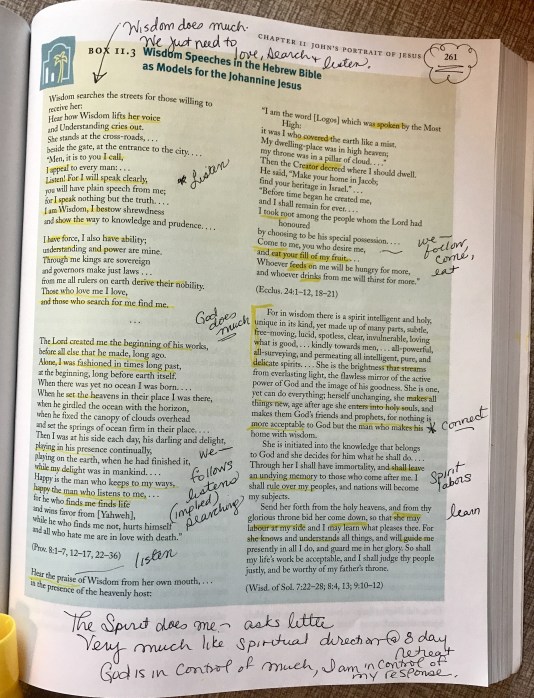
But I had an aha (!) moment and I have to capture it. Technically, it’s two aha (!) moments that converge, but anyway, here goes—a creative attempt at procrastination cloaked in inspired productivity.

The past several days I have read all four Gospels of the New Testament—Matthew, Mark, Luke, AND John. And not just the miracles or the well-known parables, but from beginning to end; every chapter, every verse. And for each of the Gospels, I’ve also read a chapter in my textbook, The New Testament by Stephen L. Harris, for a class I’m taking at Creighton University. Each chapter comments on key topics, themes, author, date and place of composition, various sources used, the intended audience and interpretations.

I don’t have the words yet for all that I’ve learned, but that’s also why I’m procrastinating. I need to find some words (very soon) to write an 1800 word paper, due in 48 hours, responding to this prompt: Explain the story of the life of Jesus as portrayed in the Gospel of John, and compare it to either Matthew or Luke and how this might relate to ministry today.

I trust the words will come, but this first. Here goes….

Surprisingly (to me) each of the four Gospels share a unique portrayal of Jesus, his life, death, resurrection, and ultimate purpose of all of the above. Ninety percent of the content in the Gospel of John is not in the other three synoptic Gospels. Who knew?

It’s hard to capture the diversity of the Gospels with just daily readings and/or what one hears on Sunday mornings. The Jesus that is portrayed in the Gospel of John parallels some of the Wisdom speeches in the Hebrew Bible.

This is where the aha (!) moment comes in.  As I read through the selections from Proverbs, Ecclesiastes and the Wisdom of Solomon, I am overwhelmed by how much Wisdom, the Spirit of God, does for me:

Wisdom

Wisdom searches the streets for those willing to receive her.  ~  Wisdom lifts her voice, cries out, stands at the crossroads, calls, appeals, speaks clearly, bestows, shows the way, fashions, plays, delights, covers, decrees, remains, takes root among the people, loves what is good and guides.  ~  Wisdom has ability, understanding, power.   ~    Wisdom makes all things new, enters into holy souls and labors at our side.  ~  Wisdom is intelligent, holy, unique, made up of many parts, subtle, free-moving, lucid, spotless, clear, invulnerable, kindly towards men, all-powerful, all-surveying.  ~   Wisdom is the brightness that streams from everlasting light, the flawless mirror of the active power of God and the image of his goodness.   ~   Wisdom permeates all intelligent, pure and delicate spirits.

And this is what Wisdom desires from me:

Listen! Love me. Search me. Keep my ways. Come to me. Eat your fill of my fruit. Feed on me. Drink from me.

Wow. God does so much for me. And asks so little.

While on retreat this summer, the spiritual director that I met with daily asked me to reflect on what God is responsible for or in control of versus what I am responsible for or in control of. As I reflected on each of my thoughts and actions throughout the day, I created this list:

god is in control

At the end of the day, it was apparent to me that very little is in my control and that very much comes from God.

God, or Spirit, is the very breath of life. I am always and forever dependent on the gift of each moment. And I am always and forever responsible for my reaction to this great gift.

God is the creator and great mover of all. My response to this is to be authentic, prayerful, grateful, committed, attentive, and discerning.  I am responsible for my actions, thoughts, and response to God and others.

I am not in control and never have been. If ever things felt “under control” or to my liking, it was just the way it happened to be, not because I had commanded it. It is a freedom to know that I don’t cause order or chaos. My role, what I am called to do, is to listen to, search for and follow God.  The Spirit of God proclaims, “Those who love me I love, and those who search for me find me .” -Proverbs 8:17

find me

God does so much and asks so little.

“Wisdom is both the means by which God creates and the channel through whom he communicates to humankind.”  -The New Testament, Stephen L. Harris

Note: This post is about 800 words so I’m hopeful that I can crank this paper out in a few days. 

Sneak-a-peak at Luke vs. John: An 1800ish word paper

God Loves a Cheerful Giver

God loves a joyful giver

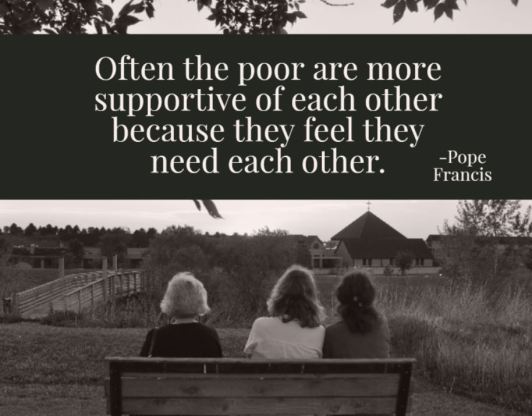
People who don’t give money to the homeless because they think it will be spent on alcohol and not food should ask themselves what guilty pleasures they are secretly spending money on, Pope Francis said. “There are many excuses” to justify why one doesn’t lend a hand when asked by a person begging on the street. (Carol Glatz, Catholic News Service, 2/28/17)

I’ve been thinking about the decision to give (or not to give) to a beggar on the street since Pope Francis suggested that giving “is always right,” whether one thinks the other is truly in need or not.  A few months ago when I was leaving a movie theater, having spent an evening out with friends, I saw a homeless man with a sign asking for money. Engaged in conversation, I quickly walked passed him. I was pretty sure I didn’t have any cash on me anyway. But later, upon reflection, I realized that I did not (or could not) look the man in the eye, and I wondered why.  If I had money with me, would I have given it to him? Would I have looked him in the eye then? I felt a sense of shame, partly for not giving him some money,  but more so because I hadn’t looked at him directly.  Looking someone in the eye honors their dignity; it acknowledges WHO THEY ARE.

poor

I have considered more that “tossing money and not looking in (their) eyes is not a Christian” way of behaving, either. Pope Francis suggests the way one reaches out to the person asking for help is important and must be done “by looking them in the eyes and touching their hands.” It honors the dignity of the other, regardless of whether we feel the other is deserving. In this way, we face our own judgments of another, our implicit bias.

When encountering people who live on the street, the pope said he always greets them and sometimes inquires about their lives and background. He always chatted with a homeless family and couple that lived next to the archbishop’s residence in Buenos Aires, Argentina, he said, and never considered getting rid of them. When “Someone told me, ‘They’re making the chancery filthy,’ Well, the filth is within” one’s heart, he said. (Carol Glatz, Catholic News Service, 2/28/17)

Several days after walking by that beggar, my husband and I encountered the same scene, a homeless man with a sign asking for money. As we walked by, not looking at him directly, I paused. We had a quick discussion about giving some money or not, and I remembered Pope Francis’ advice: It is not my job to determine whether this man is truly in need or to be concerned about where the money shall be spent. And it’s not even about whether I can afford a dollar or two, of which I am quite able. If I can’t spare a dollar after having a lovely dinner on the way to a concert, then it says more about me than the beggar.  Continue reading “God Loves a Cheerful Giver”

Many Ways to Pray: Take a Hike

always we begin againThere are many ways to pray. Really all of life can, and should, be a prayer. We are never not in connectedness with God, but it is in prayer that we become aware of this union even more.
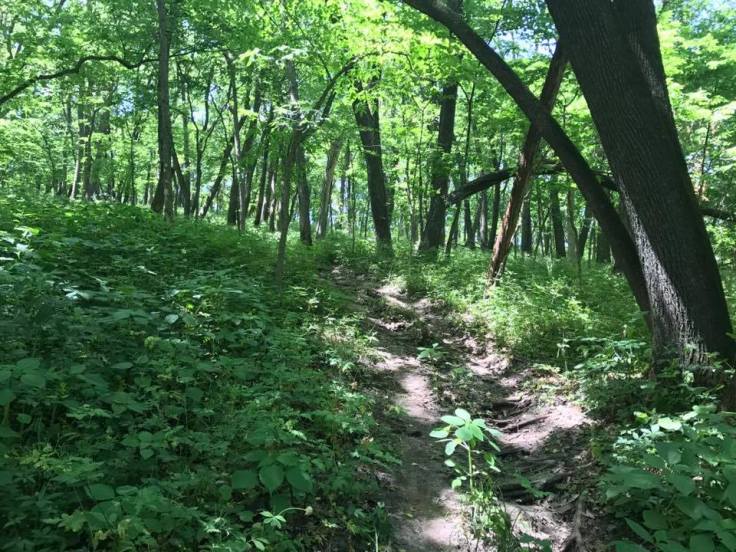
Recently, I shared an experience of walking a labyrinth, an ancient portal to prayer that has only one distinct path on which to walk; it is not a maze as some misunderstand it. A maze typically has just one correct path, but it has many confusing choices and dead ends that lead to nowhere obliging one to make a decision about which path to take. One may have to “begin again” several times before completing.

St. Benedict, in his Rule, encourages his monks to always begin again. He knew there would be times when life, even our prayer life, could be more like a maze than a labyrinth. Despite its challenges, our maze-like experiences are a prayerful opportunity to practice awareness, patience, and gratitude. 

19149428_10212997687927260_6273485265180574605_n

I had this opportunity recently. Surrounded by the wooded hills of western Iowa at the Creighton University Retreat Center, I attended an eight-day silent Ignatian retreat. I was excited to take the loop hike that goes down to the Nishnabotna River. I love to be in nature and believe wholeheartedly, that “every time you admire something in nature, it’s a prayer to the Creator.”  (Vernon Harper)

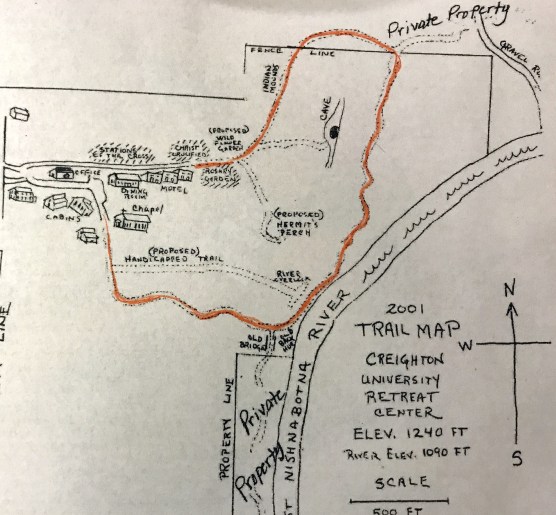
trail map

Note the easy-to-read map: one can enter the loop hike from two different points and arrive back to nearly the same point.

I started from the north end of the property, but the path seemed overgrown in areas and I wondered if I was on the right trail. Soon enough, there is a fork where I could go right or left. I went right because it seemed the better path. Eventually,  I came to a very steep decline that I wasn’t sure I could navigate. Surely, I thought, I am on the wrong path.

Better safe than sorry, I hike back and take the left path instead. I hike and hike. I end up at yet another steep decline.  I’m no sissy (I have walked on a treadmill with a 10% incline for goodness sakes), but I think this might not be the right path either.  Tired and sweaty already, I decide it’s better to cut my losses and start out at the south end tomorrow where there might be a clearer path.

Desktop11

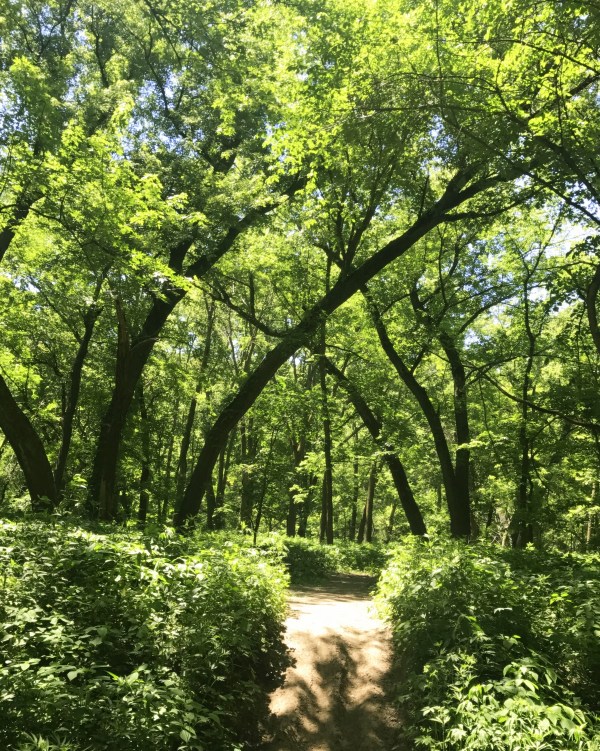
It’s a new day…feeling good and my selfie shows it!  I begin again, this time from the other side of the property.  It was a much better trail. Birds chirping, deer scampering, butterflies flying and silence—this is the prayerful connecting-with-God-and-nature hike I was expecting.

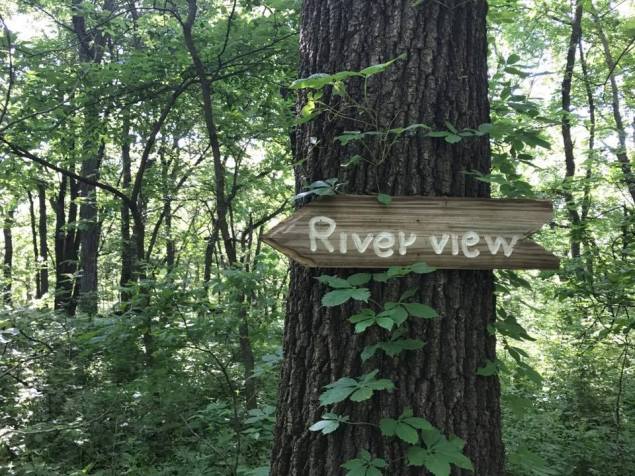
Wait, what? Hmm, a choice of two paths—the lower trail or the River view trail. I choose the river view…the whole point of the hike, right?

Riverview sign

Wrong.  Note: this necessary decision is not on the map. I hike to the river view and sit for a moment on a bench to view a sliver of the river. Hiking to the left, I find an even steeper decline than the day before. Hiking to the right, a dead end.

trail dead end

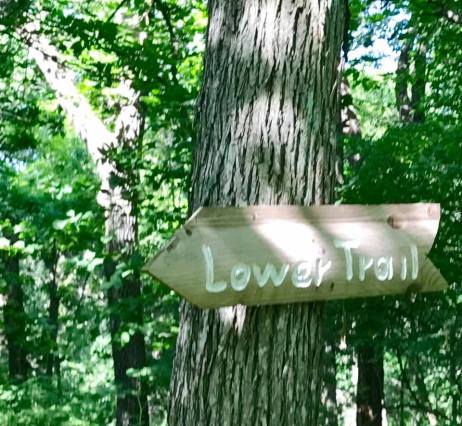
I hike back to the original choice of trails and take the lower trail.

lower trail sign

I hike for about an hour (the time estimated for the hike) with many choices of trails (which I did not expect….remember, it’s a LOOP and not on the map). If there’s a wrong choice of trail to take, I take it.

I hit several dead ends: at the river, at a sign that reads “End of CU property”, at a few very steep inclines, and at a cave. My love of nature and the enjoyment of the journey is challenged. “Always we begin again” has been replaced with, “Will I ever get out of this maze?”deadend collage.jpg

I considered turning back, but I just couldn’t bring myself to “begin again” two days in a row.  It would take another hour to retrace my steps. Yesterday it was the right thing to begin again but today I need to focus on the present and future, and leave the past in the past. A lot like life, I think. “Always go forward and never turn back.” (St. Junípero Serra)

I consider walking the river until I  meet a road; thinking surely there will be a road eventually.  (So like some life situations: Can I just bail now?) I know this is the panic speaking so I retrace my steps back to a fork in trails and a sign that reads, “Upper Trail”.

Upper Trail is a hike up and up and up and up, likely one of the very steep trails I encountered the day before that I felt incapable of going down. I laugh. I take a short break for a few minutes…and then continue up and up and finally, I am on a walking path. I have to be close now. I see a shed. Wait, no, I don’t. Dear God, it’s a mirage. I laugh again at myself.

I consider taking an “after hike” selfie but know that it wouldn’t be web-worthy and would challenge the “sweat is good” attitude I’ve tried to attain. I realize I have seen NO ONE on the trail in over an hour. Have the others heard the trail isn’t really a loop? Thank God, I have my cell phone. Could I be found if I called for help? I don’t think it’s possible to die from thirst or hunger this close to….wait, I see a building. A real one this time.

I have arrived. Relief.

home

“In every walk with Nature one receives far more than he seeks.”  -John Muir

I received more than I was seeking, no doubt. A simple loop hike turned into a frustrating and, in hindsight, funny experience.  I took only short hikes for quite a few days, but as the end of the retreat neared, I knew I needed to challenge myself to the “loop” again. Surely, it would be easier now that I had done it.

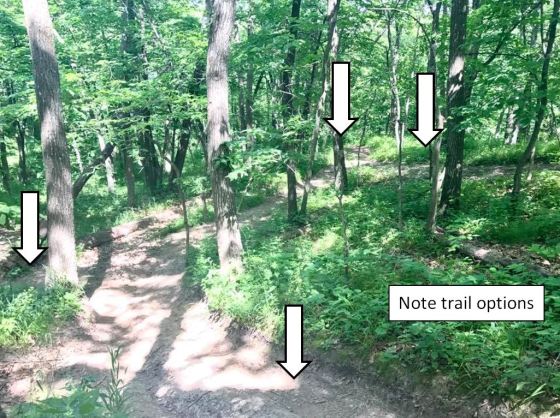
The trails were familiar so I trusted myself and the route I chose. I hiked this time with a new set of eyes. I noticed things I hadn’t before—the signs seemed more clear and logical, sounds from each of the birds were clearly unique, a turkey family trotted quickly into the trees, blue insects escaped into cracks in the dirt, and there were forks in the path I hadn’t noticed before. But, this time I felt more comfortable being adventurous and going down those uncertain paths.

DSC_0113a

With experience behind me, I knew when I had come to the final fork in the trail. I hiked up the last hill and when I came out of the top, I realized, NO, that I was not at the end of the loop but at another offshoot! I laughed out loud. My confidence did not waiver; now I was able to trust where I was and navigate back to more familiar terrain.

trail options

Sometimes we must begin again. And when we do, we bring what we have learned from earlier efforts. I find this in my spiritual life as well. The more I pray, the more I trust. When I become afraid or anxious, I begin again. I go back to my faith, to prayer, and trust that God has been there before and always will be. I just need to begin again. 

When we finally broke our silence at the end of the retreat, I realized I was not the only one that had this experience. Everyone else had gotten lost in the woods too. Now isn’t that just like life? There are no new problems under the sun.

No one, not even our closest soul friends can “hike the loop” for us, but, thankfully, they share with us solace, encouragement, and prayers.  This journey is our own. We learn on the way. We are accompanied. And always we begin again

And for future hikes—this is a better idea of what the map should look like.trail map2

Recommended article: “How Hiking Can Help Your Spirituality“, by Megan Bailey at beliefnet.  


Many Ways To Pray: Walking A Labyrinth

“There are hundreds of ways to kneel and kiss the ground.” –Rumi

There are many ways to pray—in song, spoken or written words, silence, creativity, nature and movement, just to mention a few. Paul recommends to “pray without ceasing” (1 Thessalonians 5:17), which is only possible if we are able to connect with our Creator in a variety of ways. We are meant to engage our senses, our whole bodies, in prayer.

I’ve come to appreciate this about the Catholic Mass, even if visitors might think there is a lot of up and down. We genuflect, sit, stand, kneel and bow. These gestures, postures or movement help to bring our whole being into prayerful expression—raising our hands when saying the “Our Father”, making the sign of the cross or receiving the Eucharist allows us to use our bodies in prayer.

lab signIn addition, walking the stations of the cross or a labyrinth, taking a nature hike, or practicing yoga or tai chi are prayerful forms of movement that engage our bodies while quieting our mind. 

This summer I had the opportunity to pray in many ways while attending an eight-day Ignatian retreat at the Creighton University Retreat Center. Each day, for about an hour, I met with a spiritual director to receive guidance and to share my faith journey; the remainder of the day was spent reflecting on these discussions and praying. One of the ways that I prayed was by walking a labyrinth.

“A labyrinth is not a maze. A maze is a symbol of life without meaning, it is an agent of confusion, deception with dead ends that lead you nowhere. But a labyrinth is a symbol of a life of deeper meaning, an on-going sacred journey leading us inward, outward and to greater wholeness.”Carrie Newcomer

lab 2

There is a clear design to a labyrinth with only one path to reach the center, albeit not direct, and the same path to walk  from the center outwards. Bringing one’s prayer to the labyrinth helps engage the mind, body and spirit.

“The labyrinth is an archetype, a divine imprint, found in all religious traditions in various forms around the world…Walking the labyrinth is a spiritual discipline that invites us to trust the path, to surrender to the many turns our lives take, and to walk through the confusion, the fear, the anger, and grief that we cannot avoid experiencing as we live our earthly lives.”  Rev. Dr. Lauren Artress

Often before starting a labyrinth walk, I offer an intention, ask a question, or prayerfully surrender a situation to God. Sometimes I carry a SoulCollage® card with me as I journey towards the center. Because there is only one path inward, the mind can let go of how one while arrive at the center. It is a certainty that I will get there eventually. I practice trusting that wherever God takes me, I will be led both inward to the center and back out. I can settle into a knowing that God is with me, that God accompanies.

This walk, or journey inward, is a metaphor for life—really all situations, relationships and decisions are a journey. So often we don’t know where we are headed, even with the best of plans or intentions. With a labyrinth walk, one has the experience of letting go of their own plan—surrendering and trusting that the center will be reached.  It is nearly impossible to rush through a labyrinth. Just imagine what that might look like at the turning points. It is actually dizzying to make the turns, circling around from one quadrant to another, if moving too fast. The best option for the labyrinth (and perhaps for all of life) is to move in a rhythmic, slow, meditative walk.

Despite the appearance of a dead end, or another switchback, the journey continues inward and will ultimately arrive at the center. The route isn’t always clear. I often wonder if I somehow lost my place. Am I just walking in circles? There may be a bit of anxiety, but trusting that the path is the right one brings freedom. If this can be transferred to our life’s journey, imagine what that freedom might be like! Wherever God takes me, whether I am led inward or back out, when I feel I’ve lost my way or the walk feels longer than it should, I am reminded that God holds the divine design to our personal journey.

labyrinth prayer

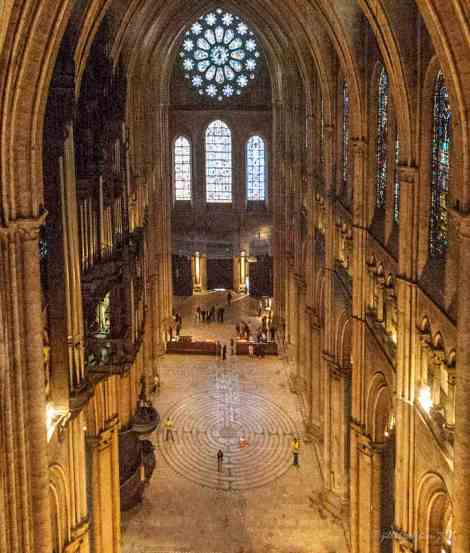
When I arrive at the center of the labyrinth, I surrender my intention, rest and pray. Recently I learned the labyrinth in the Chartres Cathedral is situated where the womb of Mary would be if the cathedral itself symbolized the head, arms and body of Mary (see Bishop Robert Barron’s description of the Chartres Cathedral and the image of Mary). It is a beautiful image to bring one’s prayer and concerns to the womb of Mary, surrendering into Jesus who surrendered for us. God makes our offering into something new; through our surrender, something in us can be birthed or transformed. The labyrinth, of course, is a symbol of this—we can surrender anytime. We are called to, as Jesus said, “Follow me”.


Wisdom Ways Labyrinth Building
Chartres Cathedral Labyrinth completed in 1220, France


Bishop Robert Barron describes the stained-glass window, perfectly shaped to reflect on the labyrinth, as a symbol of heavenly light shining on the womb of Mary, receiving the light of Christ as the bearer of the divine word. Spending time in the center of the labyrinth, we can make personal Mary’s acceptance, “Be it done unto me (Luke 1:38).” We surrender as Mary did when she received the news from the angel Gabriel in the Annunciation.

“Growth is a spiral process, doubling back on itself, reassessing and regrouping.”-Julia Cameron 

The journey outward is a continued expression of the prayerful surrender. It occurred to me while walking outward that I was moving more quickly. I was in a bit of a hurry even. Almost as if to say “I surrender, but please, answer my prayer quickly” or “There, I did it! I surrender. Done!”  I am aware that I prefer difficult situations to be “fixed” now. I want a resolution; I don’t want to wait for an answer or solution. I don’t want the pain of the journey. I want to get straight to the center and back out again. Of course, the hurrying really doesn’t work. Staying attentive and slowly walking the walk is the only way to stay in God’s presence, to truly surrender. 

Walking the labyrinth brings new insights each time—about the process itself, as a metaphor for life’s journey, and about the situation in need of prayer. Praying while walking a labyrinth can be combined with many other forms of prayer as well.


labyrinth and card
A SoulCollage® card I made to represent a recent dream.


 I love labyrinths and am so excited about one being built at St. Benedict Center! “Its model is the famous labyrinth in the Cathedral of Chartres, France.  When the Holy Land was closed to pilgrims in the Middle Ages, labyrinths abounded in the churches of Europe.  They were used to symbolically represent the pilgrimage to the Holy Land.  Our life is a pilgrimage, a journey to our eternal home with God in heaven.” –Father Thomas Leitner The labyrinth will be completed by spring 2018.

DSC_0925a

Consider attending a retreat I am leading hosted by St. Benedict Center called Living in the Fullness of God, October 27-28, 2018. Through prayer, we grow in the fullness of relationship with God. “The fullness of joy is to behold God in everything” (Julian of Norwich). What does it mean to live life to its fullest? Is it possible to always live with joy? Explore the paradox of embracing joy and sadness, light and darkness, birthing and dying, God in all and God within as we explore our greatest joy—that we are created in the image of God and we are created to create! Embrace the fullness of God’s gift of creative prayer including lectio divina, SoulCollage®, guided meditation and a labyrinth walk.

labyrinth June 2017


Blog at WordPress.com.

Up ↑