Thoughts and Prayers, Guns and School

These past few days our social media feeds have been filled with messages of thoughts and prayers for the victims of yet another school shooting. And there are just as many posts that reject what may seem like Pollyanna, feel-good greetings:

thoughts and prayers 2thoughts and prayers

I understand both perspectives. I want to “LIKE” the thoughts and prayers posts and the posts that say prayers are not enough.

I send my thoughts and prayers to all the families who have lost loved ones because I believe in prayer. My heart goes out to the parents who have lost their beloved children, bursting with potential; for the teachers, inspired to share a passion for life-long learning; for the students who survived, the students who saw their friends die, and the students who will have nightmares for weeks, months and years to come from this trauma.

I believe in the power of prayer to change the person praying and to affect the situation being prayed for. When I pray, I am sending my heartfelt condolences and positive energy to a specific person and/or for a situation. And I know it works—I’ve felt it myself when others have prayed for me. I can only hope it makes a difference when I pray for others.

prayer

But I believe that giving only lip-service to prayer can be a cop-out, a way for some to avoid the responsibility of facing real issues. “Thoughts and prayers” can sound hollow without action, effort, or work towards change.

Prayer must be accompanied with authentic listening and selfless action. St. Benedict refers to this as “ora et labora” or prayer and work. This Benedictine motto has application beyond the monastery.

God empowers us and encourages us to put our prayers to work. Prayer alone is sentimental; work alone lacks heart and soul. It is not either prayer or work, but both prayer and work that can make an impact on those we love and for situations that need healing. We need both prayer and work.

This either/or thinking is what has brought our country to be divided on more issues than I can name here (besides, it just exhausts me.) There is not one single reason that America has found itself the leader in gun murders; there are many.

gun murders

A teacher colleague, Alan Holdorf, wrote, “We have a gun problem. Or we have a mental health problem. Or a discipline problem with our children. Can we have all of the problems? Then again, how silly would that be to have a multi-faceted problem that can’t be tackled by a single hot-button issue.”

Of course, America’s problems are multi-layered. There is something Americans are doing differently than other countries. There is something we are doing wrong. It is undeniable, but there isn’t one simple solution to our complex problems. The solution is not one thing or another, it is a both/and situation. There are layers of possibilities for addressing what ails our country, but for God’s sake let’s do something.

This crisis of gun violence in America is an opportunity to be open-minded listeners and to be leaders sans political agenda; to be compassionate and to detach from our own opinions long enough to realize that we all want the same thing—for our children to be safe in their learning environment.

It’s being humble enough as people, as a country, to say that we aren’t getting it right yet. We aren’t great and we never were. We have a long way to go to make all of America feel safe, let alone great.

But America and my classroom are two different things.

flag

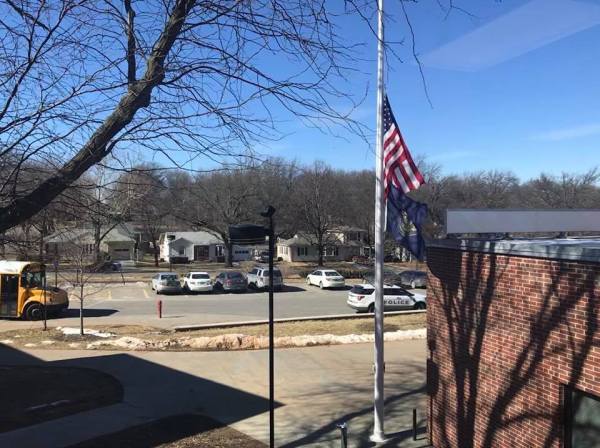
My heart belongs to the classroom. I look out my window at the flag flying half-staff, and I am reminded how much I love my students and want them to succeed. I want them to become their best self, to reach their fullest potential. I grieve when I see that a student comes from an environment that doesn’t encourage or support that.

Students have so many more issues than they did when I started my career in education 21 years ago—there are m­ore broken homes, mental illness, learning disabilities, poverty, personal and family trauma. Teaching has become much more than delivering curriculum, it is about connecting to the heart, soul, and mind of my student.

But this does not require me to carry a gun—that’s too easy. An eye for an eye makes everyone blind. Instead, some policy decisions need to be made to prevent school violence. Some decisions need to be made to give teachers the tools they need to connect with and help our most vulnerable students. I will continue to PRAY and WORK towards this goal. 

“I’m a teacher and you want to arm me? Then arm me with a school psychologist who has time to do more than test and sit in meetings about testing. Arm me with enough counselors so we can build skills to prevent violence, and have meaningful discussions with students about their future. Arm me with social workers who can thoughtfully attend to students and their family’s needs. Arm me with enough school nurses so that they are accessible to every child. Arm me with more days on the calendar for teaching and learning and fewer days for standardized testing. Arm me with smaller class sizes that allow my colleagues and I to get to know our students and their families better. Arm me with community schools that are hubs of educational, cultural, health and civic partnerships, improving the entire community. Until you arm me to the hilt with what it takes to meet the needs of our school and students, I respectfully request you keep your guns out of my school.” Source: UTLA, video below.

My word for the year is…

You know how spiritual gurus encourage you to pick a word of the year, something profound and inspirational to help you navigate a new year? Well, I found mine the other day. I had contemplated some lofty sounding words, but I don’t even remember them now because when this word fell on me, I knew it was the one.

My word for the year is going to be cushion.

cushioned either way.jpgCushioned, either way. Loved, either way.  Card created for Word of the Year, 2018.

When I have a lot of activity then I need to cushion it with some non-activity, some silence and solitude. When I have a lot of sitting, I need to cushion it with more standing and walking around (this I’ve learned from my back injury.) I love the “vorfreude”, the anticipation of travel, but my adventures need to be cushioned with the feeling of contentment when arriving home, sweet home. And the times when I think I can pour just a bit more information into my brain by reading one more article or one more chapter, I shall give myself a cushion, the needed space for new thoughts and ideas to bubble up.

Once I was taken with the idea of cushion as my one-word guide to freedom and happiness in 2018, I couldn’t stop thinking about the various applications. For instance, I should like to give myself a soft place to fall, a cushion on those days when I am too hard on myself. And when I’m too hard on others or expect too much, I can imagine a cushion between them and me. I can be a little softer and a little more forgiving, a little less rigid and a little more relaxed.

Really, it’s about balance, an invaluable tool of Benedictine spirituality that helps one stay in present moment experience, having enough silence and space to listen with the ear of the heart.

balance
One of the first cards I made, titled “Balance”

I remember how Fr. Mauritius demonstrated what balance looks like at a retreat he directed.  Standing in the center of the room, which represented having a perfect balance, he shared that it is impossible to always be in a perfectly balanced state of being. Rather, what we do is go a little too far to the left (say, with committing to too many social engagements) or a little too far to the right (perhaps, with too much isolation.) To demonstrate how we so often get out of balance, Fr. Mauritius physically ran to the left side of the room and bounced off the wall. And then to re-correct, an attempt at finding balance, he ran to the opposite side of the room and bounced off that wall.

balance2

Our life is a constant attempt to achieve some kind of balance, but perhaps our efforts can be made more gently. This bouncing off the wall is what I would like to avoid in 2018….with my cushion. Instead of overcommitting, I will take the time to ask myself—will this be too much? Am I overcommitting? Is this a physically, emotionally and spiritually healthy way for me to spend my time?

Additionally, I shall allow myself the cushion of time needed to make any decision. There is no need to rush, to overcommit, to bounce off that darn wall so hard. I shall gently bump into the ever-so-soft cushion I have gifted myself as a reminder to listen to the ear of the heart.

Speaking and silence.
Together and alone.
Activity and rest.
Prayer and work.

The connection between these two good options is the word “and”, not “or”. We need both. We need balance, yes, but we can give ourselves a cushion, the opportunity to rest knowing that perfection is not expected. We listen. We act. We pray. We readjust. “This is how a Benedictine’s day is. It is always changing, alternating—praying, working, resting. This is captured in the Benedictine motto, pray and work…The most important word is ‘and’.” -Fr. Mauritius Wilde

Perhaps, this cushion, this soft place to fall, is what love is.

I want to give that cushion, that love to myself. I pray my loved ones know that I can be their cushion, a soft place to fall when they need to know the love of another. “Love one another.”-John 13:34

And, finally, for myself and others–to remember that meeting God in prayer is the ultimate cushion“God is love.” 1 John 4:8

love merton

In place of confusing life patterns, the security of a healthy balance”, The Holy Rule of St. Benedict with Fr. Mauritius Wilde OSB

Listen to the Word of God”, The Holy Rule of St. Benedict with Fr. Mauritius Wilde OSB

Our Life is a Balance”, Being Benedictine,  January 2017 Oblate Reflections and Lectio Divina

My 2017 Word of the Year—Be Excessively Gentle: A New Year’s Un-Resolution, SoulFully You

Rome ~ Layers Like Lasagna

There are layers of history in Rome—“layers like lasagna”—one tour guide suggested. Literally, layers were built on top of layers, buildings that had been destroyed by war and natural disaster were covered with dirt and new buildings were erected over ruins. Symbolically, many Christian churches were built over ancient pagan sites.

The architecture, art, and religious history communicate something spiritual, a deeper story with layers of meaning, like lasagna. I’ll share some of my favorite places, and the journey, from my trip to Rome to attend the World Congress of Benedictine Oblates:

St. Peter’s Basilica and the Scavi tour

On my first morning in Rome, I had scheduled a visit to St. Peter’s Basilica and the Scavi tour of the necropolis beneath, including St. Peter’s tomb. My plan was to have a taxi drop me off where I needed to be to start the tour for a stress-free morning, no need for coat and umbrella, and no need to hurry. Where I thought I could find a taxi, there were none; where a distracted police officer pointed, there were none. A little nervous, I decided I should just start walking in the general direction of the Vatican or I may not get there in time. Surely, I would see the large dome and signs along the way. There were none.

This slideshow requires JavaScript.

I remember that the Vatican was just to the left of the Tiber River as it changes directions. With this vague idea, I set off on a lovely tree-lined path along the Tiber River. The views were beautiful—this will be just fine, I say to myself, I have plenty of time.Getting a little chilly, but I’ll be there soon. The online map said a 45-minute walk. Oops, a few sprinkles, a few more. Darn it, why didn’t I bring the umbrella I had packed?

 I reach the point where the Vatican should be but I see no less than six different options to take; I see no dome and no signs. In panic mode now, with it getting colder and sprinkling more, I ask a woman, “Where is the Vatican?”  Mind you, I had asked one young couple who responded, “In hurry, no time” and another woman who circled herself saying, “hmmm” whom I decided not to trust for accurate directions, but this woman—she is my angel. “No English. I take you,” she said. Oh, thank God.

DSC_0217a

She takes me a few blocks to the intersection where I finally see St. Peter’s Basilica (and its dome. Who knew the Vatican was surrounded by other tall buildings? Not what I had pictured.) I have finally arrived, yet I still need to walk several blocks in light rainfall, so I duck into a little storefront outside of St. Peter’s Square and buy an umbrella. Better safe, than sorry, I think.

Thirty seconds later, new umbrella overhead, I experienced the hardest rainfall I’ve ever walked in (outside of the time I got lost in Munich, Germany …. hmmm, seems to be an international pattern). I arrive at the gate of the Swiss Guard in plenty of time to stand in the cold and rain for at least 30 more minutes before the tour began. Still, I am grateful I walked. I learned, and saw, much more than I would have had I been delivered directly to St. Peter’s Square. There are layers of meaning when you surrender to the journey. 

DSC_0321a

The tour was quite amazing, but I was most struck by the case the guide built throughout the tour that the Basilica was indeed constructed over St. Peter’s tomb. The area beneath St. Peter’s Basilica was only discovered in the 1940s and during excavation, archaeologists found a 4th-century burial ground and a grave marked with ancient lettering translated, “Peter is here”.  I was so touched by the reverence our guide showed letting each individual participant have a few moments to privately view the site. It was a moment for the heart to remember only; no photos were permitted on the tour. Nearby the guide pointed out an elaborate grate in the ceiling—directly above, one could hear the prayers and responses of a Mass in progress in the Basilica. For centuries, what laid below was hidden. This faith, built on a grave, has layers of meaning, like lasagna.

DSC_0250a


I had plenty of time to explore the Basilica and its side chapels in quiet solitude when I went on my own, but on the World Congress of Benedictine Oblates group tour we learned some of the symbolism behind the artwork, altars, and relics from a guide. I learned the bronze statue of St. Peter holding the keys of heaven was a pilgrimage itself—for centuries pilgrims touched or kissed his right foot, literally wearing it thin, to receive a blessing from the Church’s first Pope, hoping the gates of heaven would be opened for them. This Catholic faith holds so many beautiful rituals with layers of meaning. Layers, like lasagna.

IMG_4493 (1)

Aventine Hill, One of the Seven Hills of Rome

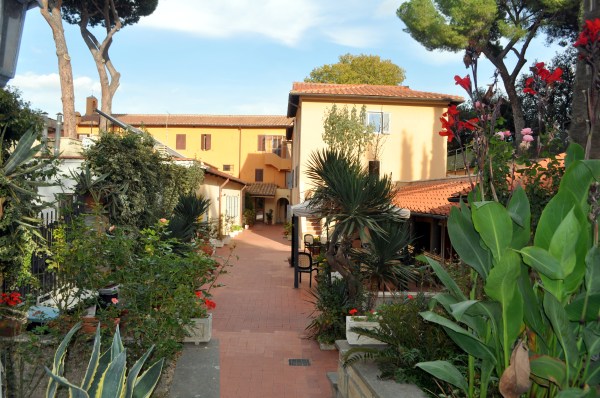
Before going to the conference center, I stayed two nights at a monastery at the bottom of Aventine Hill, chosen to be near Sant’Anselmo all’Aventino, the monastery of Fr. Mauritius Wilde. Located in a surprisingly residential area near the Coliseum, I favored the solitude and quiet of the crooked, narrow street lined with gardens, parks and ancient churches to the bustle and crowds of St. Peter’s Basilica.

DSC_0413a

DSC_0405a

On the leisurely journey up the hill to visit Fr. Mauritius, I visited the Basilica of Santa Sabina, the oldest Roman Basilica built between 422 and 432, where Pope Francis celebrated Ash Wednesday.  Traditionally, the Pope begins the celebration at Sant’ Anselmo’s, walking on foot from one basilica to another, to celebrate the beginning of Lent. Further up the hill, I visited Santi Bonifacio and ­­­Santa Prisca, as well as a park that overlooked the center of Rome, and the famous Knights of Malta Keyhole that outlines a view of St. Peter’s perfectly.

DSC_0425a

It was a delight to see Fr. Mauritius, who moved to Rome after serving as Prior for six years at Schuyler’s Christ the King Priory. After a behind-the-scenes tour of the academic center, monastery, chapel and grounds, we enjoyed conversation on the patio. I had kept in touch with Fr. Mauritius since his move the year before, but this revealed another layer, like lasagna. There is a contentment knowing just where my friend’s home is, to know where he works and prays.

This slideshow requires JavaScript.

St. Benedict’s cell at San Benedetto and Montecassino Abbey

Both destinations were a highlight of sacred sites visited—first, the cell of St. Benedict while he studied in Rome (about the year 500) before founding his first monastery in Subiaco. The cell, or small room, has been preserved; a small chapel adjacent, San Benedetto in Piscinula, dates back to the 12th century. I loved, LOVED, loved this special place. I could have stayed there for hours. To know that St. Benedict listened “with the ear of his heart” in this very place, rejecting the political corruption of Rome and what was expected of him, to pursue the call he knew was from God—well, for a Benedictine Oblate, this is a moment. Had I not been in a group with a full sight-seeing schedule, I would have likely spent a half-day in contemplation at this chapel.

DSC_0399a

DSC_0409a

After a beautiful drive in the countryside east of Rome, we arrived at the Abbey of Montecassino where St. Benedict wrote his Rule. We were welcomed, after a foggy drive up the mountain, by clear skies and a heartfelt blessing at Mass—“This is your house as Benedictines,” the priest said, “St. Benedict welcomes you, hugs you, blesses you.” After Mass, we visited the original part of the Abbey, dating back to the 5th century, which had not been destroyed during World War II. This was another profound experience—to be in the place where the Rule of St. Benedict, a guide for monastics and oblates for over 1500 years, was penned. Later we met a gentleman who, as a little boy, had taken refuge with his family at the Abbey during the War, hoping to be safe with the monks high on the mountain. How devastating war is, how many layers there are—for this young boy and his family, the nearby town and, ultimately, the Abbey, bombed in the Battle of Monte Cassino. There are no winners in war.

This slideshow requires JavaScript.

Place is a powerful thing

It gives us perspective, a sense of where we’ve come from and how we’ve gotten here. The Christian story unfolded in this place of Rome. I am so grateful to have experienced this place of Peter and Paul, the places of St. Benedict and so many other holy places.

But I remember that home is holy too.

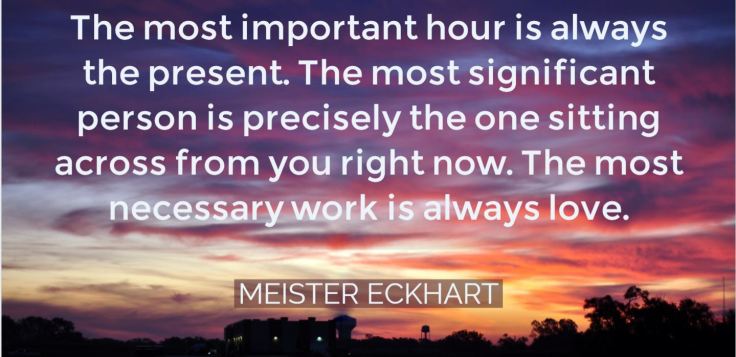
Home is where I work out the tension between stability and conversion. Home is where I listen to the ear of my heart. Home is the most important place; it is our present moment. Home is the people you surround yourself with, our friends and family. Our story unfolds at home. This is where we uncover our many layers, like lasagna.

lasagna
My first meal in Rome–lasagna!

Rome: Packing and unpacking can be a lot of work

It’s been a little over a month since I’v­e returned from Rome. I’ve reported on official business of the Oblate Congress in a four-part blog series on Being Benedictine.

DSC_0018a

It takes me awhile to unpack my feelings and the higher purpose or meaning within my experiences, but I’m getting there. For so many months I was filled with vorfreude, German for “anticipatory joy”, that bursting-with-excitement, overflowing-with-enthusiasm, oh-my-God-I-can’t-believe-this-is-happening-to-me-this-is-a-trip-of-a-lifetime feeling (just like the Germany pilgrimage.)

Here are a few things I’ve unpacked so far:

Worry is hardly ever worth it. 
Before I left, I confessed I felt guilty taking time away from school, that I was nervous about leaving my classroom for so many days. But it turned out there was absolutely nothing to worry about. Projects and assignments were graded, questions (if there were any) had been dealt with, students worked hard and truly didn’t miss a beat. I am so thankful for Karen Kay, my former department chair, friend and substitute teacher extraordinaire for giving me the gift of peace of mind and an easy transition back into the classroom (despite the jet lag)!

DSC_0019a

Things often turn out differently than expectedSometimes there are disappointments, sometimes pleasant surprises—the Rome experience was no exception. The night before I left, I pulled a muscle in my back while packing. It was one of those I-thought-that-only-happens-to-old-people moments when I simply bent down but did not come back up in a painless fashion. The pain ripped up my back, down my leg and I collapsed on the floor.

So many feelings—pain, fear, self-pity, anger, sadness, pain, worry, pain—coursed through me that evening, during a sleepless night and into the morning when I became worried that I wouldn’t be able to make the trip. And what if I did go and couldn’t walk when I arrived? But this was a trip of a lifetime, well-planned and prayed for, I was determined to go. I might as well try, I told myself, inching my way to my parent’s car to go to the airport.

DSC_0029a.JPG

It’s always about the people.
Before I even left, my heart was full of love and support from those who sent wishes of joyful and safe travels. Oblate friends, Betty, Teresa, and Diane, gave me a special blessing and Dee promised to pray a novena and have her husband light candles for me at daily Mass while I traveled. The prayers helped sustain me and give me confidence during some uncomfortable times.

Because I was so busy before I left, my husband got spending money and exchanged it for Euros at the bank, helping to take a few things off my list of things-to-do. When I became concerned that my accommodations would be too far away for sight-seeing, Fr. Mauritius helped secure a room for me at a monastery on Aventine Hill just a few minutes from his.  The night of my I-guess-this-means-I’m-old back injury, my friend, Beth, gave me a new box of pain relief patches for the journey and my physical therapist friend, Barb, gave me advice for surviving the long flight. On the way to the airport, my dad hurried into the pharmacy to get a prescription for me.

At the airport, the kind woman checking me in asked if I needed help lifting my luggage onto the scale (thank God, under 50 lbs) and the sweet young lady who sold me a snack noticed that I was a teacher (since I was proudly wearing my I ♥ Public Schools t-shirt) and said, “Keep makin’ the world go ‘round, darlin’!”

These simple, thoughtful words and gestures made such a difference to me. Love one another, it really works. “And be ye kind one to another…” -Ephesians 4:32

DSC_0055a.JPG

Amazingly and miraculously, the flight wasn’t terribly uncomfortable. Even without back pain, an international flight can be rough, but I was providentially seated next to the sweetest special needs woman from New York City named Dorothy, “like the Wizard of Oz”, she said. This introduction began a lovely 8-hour relationship that still brings a smile to my face.

Looking over the beverage menu before our flight even took off, Dorothy exclaimed, “They have Starbucks coffee; this airline is first class.” Later when Dorothy was asked if she wanted sugar with her coffee, she responded, “No, sugar. I’m already sweet enough.”

Traveling with a group and a few counselors helping out, Dorothy said she wants to “travel all around the world.” When I asked what was taking her to Rome, she said “I work at the Shop and Go and I paid for this trip. I work hard for my money.”

The day before, her counselor had taken Dorothy shopping. She got two new pairs of jeans and a shirt and she told me not to tell anyone, but she also snuck a pair of jeans in the cart that she really liked. She had cleaned her room that morning and had done laundry. She was thrilled to get free earbuds, to have video games to play and a variety of animated movies, including Cars 3, for entertainment.

Whenever anyone sneezed she said, “God Bless You”, when she needed something she said, “Jodi, Jodi, I need help”, and she mentioned a few times that she hoped she would have a coffee pot in her hotel room. Dorothy loves coffee.

A kind heart and simple mind, Dorothy truly lived in the moment. She kept busy with entertainment while I napped. I learned when we landed that she had slept not a wink on the eight-hour flight. She enjoyed it to the fullest. I thought of Dorothy a lot in Rome and since I’ve been home.

DSC_0152a

Miracles happen.
I survived the flight with very little pain. When I got off the airplane, I could walk. When I was dropped off at the wrong entrance to the monastery where I was staying for a few days, I was able to pull my luggage around the block and even help carry it up three flights of stairs to my humble accommodations.

After a Roman nap, I explored the area near me—including quaint, crooked streets, simple churches, ruins and the Colleseum. I walked over 6 kilometers and enjoyed my first Italian meal of lasagna and red wine. And I was in very little pain. I was grateful, so grateful, to be moving, to have arrived.

Rome. It begins.

I guess there will be a part 2 to this post.

Packing and unpacking can be a lot of work.

DSC_0183a.JPG

Rome: Confessions, Truths and Carpe Diem!

Confession: I feel a little guilty for taking nine days off during the school year.

Truth: But not enough that I wouldn’t seize this once-in-a-lifetime opportunity to travel to Rome.

It’s unheard of for a teacher to take off two weeks during the school year. First, we only get eleven days off for sick or vacations days per school year. Second and more importantly, it’s a lot of work to be gone, planning what students will do, securing a trusted substitute teacher to deliver curriculum, and “letting go” of controlling my classroom. (Perhaps this has something to do with being a bit of a perfectionist, control-freak, as I’m learning about Enneagram, Type One.)  Usually, teachers take time off for a wedding or funeral, a child starting college, an important doctor’s appointment, but a two-week long trip? Nope.

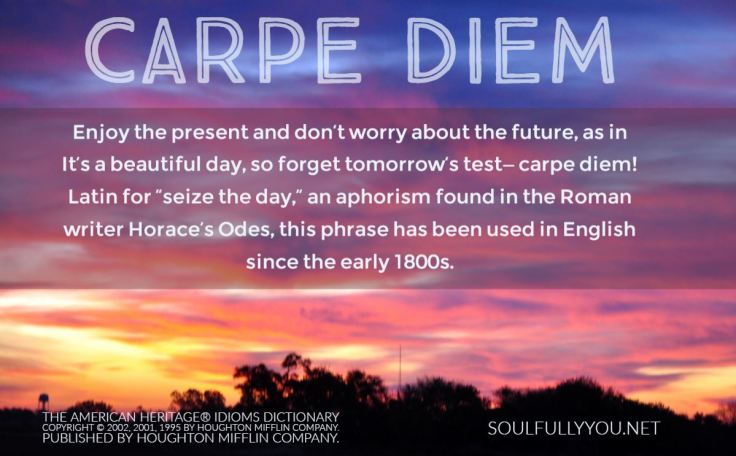
After reviewing my teaching contract, I knew I didn’t need formal permission to take the nine days off in a row, but it was important to me that I have my principal’s blessing because it can be just as difficult for students when teachers are absent. But, Principal Brent Toalson was so gracious in understanding my unique request to take time off. He agreed with what I strongly believe: life is short and it’s important to seize the day when opportunities come.

carpe diem

Confession: I’m a little nervous about leaving my classroom for two weeks.

Truth: I have no reason to feel nervous because I have an amazing substitute teacher, Karen Kay, a retired business teacher and my former department chair, who will step in and do everything perfectly (I think she’s probably an Enneagram One, too.)  When my mother-in-law passed away two years ago at the beginning of the school year, Karen taught the first week of classes for me. It was the best start of a school year my students ever had!

So CARPE DIEM!! I’m off to Rome to attend the Fourth International Congress for Benedictine Oblates. The conference is hosted every four years for Benedictine oblates, novices and oblate directors from around the world.

Oblates are ordinary people who want to live as a monk in the world. Affiliated with a specific monastery (for me, that is Christ the King Priory in Schuyler, Nebraska), oblates strive to become holy in their everyday life, in their family and their workplace. Oblates promise to live a prayerful life according to the Rule of St. Benedict. I write about being an oblate at Being Benedictine.

being ben

The Congress theme, A Way Forward – The Benedictine Community in Movement, will provide encouragement for oblates to be peacemakers in a broken world, sharing hospitality in the face of war, terrorism, refugee crises and religious fanaticism, and to be stewards of an abused planet as challenged and inspired by Pope Francis in his encyclical “Laudato Si”. Surrounded by chaos, idolized entertainment, digital noise, and consumerism, oblates desire a life of silence, contemplation, and simplicity.  We hope to answer the question: How can we as oblates create and contribute to communities around us – in our oblate groups and chapters, in our families and neighborhoods, in our workplaces, in our own monasteries of oblation and in society as a whole?

Oblates desire to be change agents in their own communities – together finding a new way forward. It sounds like a daunting task, a tall order, and very serious business. But as an oblate, I have hope that each of us can do our part to encourage peace.

A few things I look forward to:

  • Meeting and hearing Keynote Speaker, Sister Joan Chittister, OSB aka my (s)hero! Joan is one of the best known international speakers on Benedictine spirituality and social justice in the world. Author of over 50 books, Sr. Joan has been a courageous and sometimes controversial advocate of social justice, especially for women, in both church and society. She founded Benetvision, a web-based movement sharing Benedictine spirituality and currently co-chairs the United Nations-sponsored Global Peace Initiative of Women. More info about Joan Chittister HERE.
  • Spending time with my spiritual director and friend, Father Mauritius Wilde, who moved to Rome a year ago to serve as Prior of Sant Anselmo Abbey. I’m excited to see where he lives and works, to walk the streets of Rome together, to sneak in a spiritual direction session and to just be in the presence of a special friend. Fr. Mauritius writes a blog and has over thirty podcasts on Benedictine spirituality.
  • Visiting historic and religious sites including the Vatican, St. Peter’s Basilica and the necropolis on a Scavi tour, St. Benedict’s cell at San Benedetto and the Abbey he founded at Montecassino and attending a General Audience with Pope Francis (I harbor a secret desire of a drop-in visit by him at the conference. I will secure selfie evidence if my dream comes true.)

Confession: I plan to post updates while in Rome, making a conscious effort to let go of some perfectionist tendencies I have of editing, re-editing, and rewriting. Another confession: I have a few dozen blog posts sitting in a folder waiting for the perfect touches. I take solace in the fact that there are few sleepless nights for those wondering when I will publish my next post.) I surrender the notion that any of my blogs are perfect anyway.

Truth: I plan to live in the present moment, seizing opportunities, meeting new friends and enjoying many new experiences. Carpe diem! 

present moment 2

God Loves a Cheerful Giver

God loves a joyful giver

People who don’t give money to the homeless because they think it will be spent on alcohol and not food should ask themselves what guilty pleasures they are secretly spending money on, Pope Francis said. “There are many excuses” to justify why one doesn’t lend a hand when asked by a person begging on the street. (Carol Glatz, Catholic News Service, 2/28/17)

I’ve been thinking about the decision to give (or not to give) to a beggar on the street since Pope Francis suggested that giving “is always right,” whether one thinks the other is truly in need or not.  A few months ago when I was leaving a movie theater, having spent an evening out with friends, I saw a homeless man with a sign asking for money. Engaged in conversation, I quickly walked passed him. I was pretty sure I didn’t have any cash on me anyway. But later, upon reflection, I realized that I did not (or could not) look the man in the eye, and I wondered why.  If I had money with me, would I have given it to him? Would I have looked him in the eye then? I felt a sense of shame, partly for not giving him some money,  but more so because I hadn’t looked at him directly.  Looking someone in the eye honors their dignity; it acknowledges WHO THEY ARE.

poor

I have considered more that “tossing money and not looking in (their) eyes is not a Christian” way of behaving, either. Pope Francis suggests the way one reaches out to the person asking for help is important and must be done “by looking them in the eyes and touching their hands.” It honors the dignity of the other, regardless of whether we feel the other is deserving. In this way, we face our own judgments of another, our implicit bias.

When encountering people who live on the street, the pope said he always greets them and sometimes inquires about their lives and background. He always chatted with a homeless family and couple that lived next to the archbishop’s residence in Buenos Aires, Argentina, he said, and never considered getting rid of them. When “Someone told me, ‘They’re making the chancery filthy,’ Well, the filth is within” one’s heart, he said. (Carol Glatz, Catholic News Service, 2/28/17)

Several days after walking by that beggar, my husband and I encountered the same scene, a homeless man with a sign asking for money. As we walked by, not looking at him directly, I paused. We had a quick discussion about giving some money or not, and I remembered Pope Francis’ advice: It is not my job to determine whether this man is truly in need or to be concerned about where the money shall be spent. And it’s not even about whether I can afford a dollar or two, of which I am quite able. If I can’t spare a dollar after having a lovely dinner on the way to a concert, then it says more about me than the beggar.  Continue reading “God Loves a Cheerful Giver”

Many Ways to Pray: Take a Hike

always we begin againThere are many ways to pray. Really all of life can, and should, be a prayer. We are never not in connectedness with God, but it is in prayer that we become aware of this union even more.
Recently, I shared an experience of walking a labyrinth, an ancient portal to prayer that has only one distinct path on which to walk; it is not a maze as some misunderstand it. A maze typically has just one correct path, but it has many confusing choices and dead ends that lead to nowhere obliging one to make a decision about which path to take. One may have to “begin again” several times before completing.

St. Benedict, in his Rule, encourages his monks to always begin again. He knew there would be times when life, even our prayer life, could be more like a maze than a labyrinth. Despite its challenges, our maze-like experiences are a prayerful opportunity to practice awareness, patience, and gratitude. 

19149428_10212997687927260_6273485265180574605_n

I had this opportunity recently. Surrounded by the wooded hills of western Iowa at the Creighton University Retreat Center, I attended an eight-day silent Ignatian retreat. I was excited to take the loop hike that goes down to the Nishnabotna River. I love to be in nature and believe wholeheartedly, that “every time you admire something in nature, it’s a prayer to the Creator.”  (Vernon Harper)

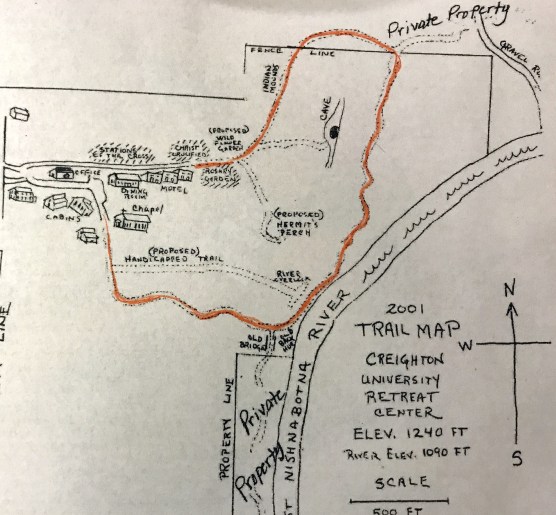
trail map

Note the easy-to-read map: one can enter the loop hike from two different points and arrive back to nearly the same point.

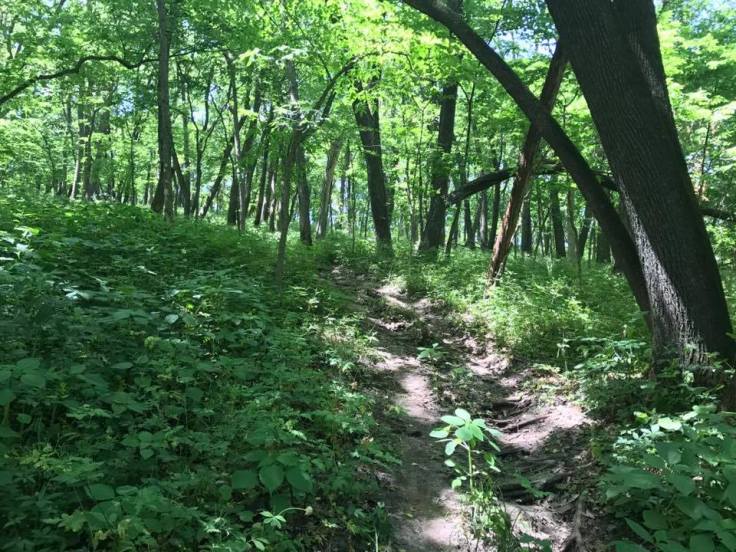
I started from the north end of the property, but the path seemed overgrown in areas and I wondered if I was on the right trail. Soon enough, there is a fork where I could go right or left. I went right because it seemed the better path. Eventually,  I came to a very steep decline that I wasn’t sure I could navigate. Surely, I thought, I am on the wrong path.

Better safe than sorry, I hike back and take the left path instead. I hike and hike. I end up at yet another steep decline.  I’m no sissy (I have walked on a treadmill with a 10% incline for goodness sakes), but I think this might not be the right path either.  Tired and sweaty already, I decide it’s better to cut my losses and start out at the south end tomorrow where there might be a clearer path.

Desktop11

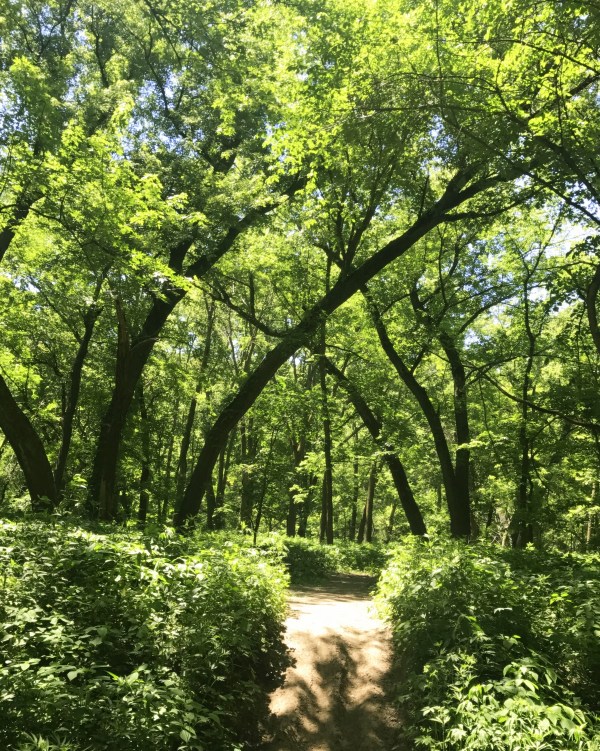
It’s a new day…feeling good and my selfie shows it!  I begin again, this time from the other side of the property.  It was a much better trail. Birds chirping, deer scampering, butterflies flying and silence—this is the prayerful connecting-with-God-and-nature hike I was expecting.

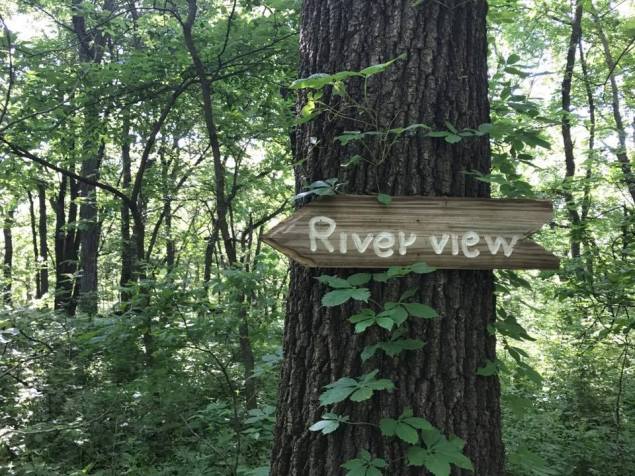
Wait, what? Hmm, a choice of two paths—the lower trail or the River view trail. I choose the river view…the whole point of the hike, right?

Riverview sign

Wrong.  Note: this necessary decision is not on the map. I hike to the river view and sit for a moment on a bench to view a sliver of the river. Hiking to the left, I find an even steeper decline than the day before. Hiking to the right, a dead end.

trail dead end

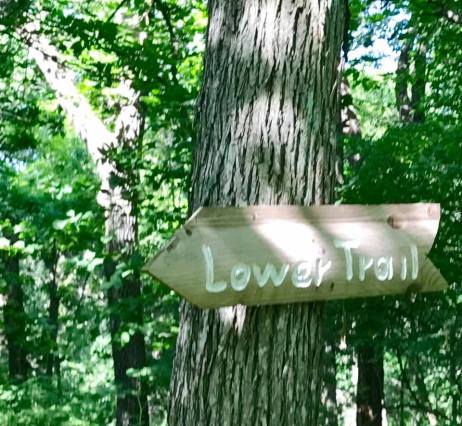
I hike back to the original choice of trails and take the lower trail.

lower trail sign

I hike for about an hour (the time estimated for the hike) with many choices of trails (which I did not expect….remember, it’s a LOOP and not on the map). If there’s a wrong choice of trail to take, I take it.

I hit several dead ends: at the river, at a sign that reads “End of CU property”, at a few very steep inclines, and at a cave. My love of nature and the enjoyment of the journey is challenged. “Always we begin again” has been replaced with, “Will I ever get out of this maze?”deadend collage.jpg

I considered turning back, but I just couldn’t bring myself to “begin again” two days in a row.  It would take another hour to retrace my steps. Yesterday it was the right thing to begin again but today I need to focus on the present and future, and leave the past in the past. A lot like life, I think. “Always go forward and never turn back.” (St. Junípero Serra)

I consider walking the river until I  meet a road; thinking surely there will be a road eventually.  (So like some life situations: Can I just bail now?) I know this is the panic speaking so I retrace my steps back to a fork in trails and a sign that reads, “Upper Trail”.

Upper Trail is a hike up and up and up and up, likely one of the very steep trails I encountered the day before that I felt incapable of going down. I laugh. I take a short break for a few minutes…and then continue up and up and finally, I am on a walking path. I have to be close now. I see a shed. Wait, no, I don’t. Dear God, it’s a mirage. I laugh again at myself.

I consider taking an “after hike” selfie but know that it wouldn’t be web-worthy and would challenge the “sweat is good” attitude I’ve tried to attain. I realize I have seen NO ONE on the trail in over an hour. Have the others heard the trail isn’t really a loop? Thank God, I have my cell phone. Could I be found if I called for help? I don’t think it’s possible to die from thirst or hunger this close to….wait, I see a building. A real one this time.

I have arrived. Relief.

home

“In every walk with Nature one receives far more than he seeks.”  -John Muir

I received more than I was seeking, no doubt. A simple loop hike turned into a frustrating and, in hindsight, funny experience.  I took only short hikes for quite a few days, but as the end of the retreat neared, I knew I needed to challenge myself to the “loop” again. Surely, it would be easier now that I had done it.

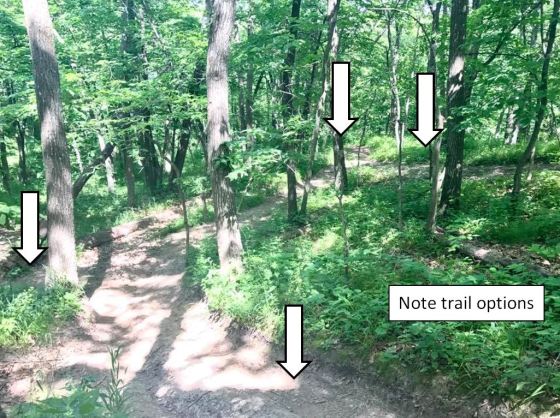
The trails were familiar so I trusted myself and the route I chose. I hiked this time with a new set of eyes. I noticed things I hadn’t before—the signs seemed more clear and logical, sounds from each of the birds were clearly unique, a turkey family trotted quickly into the trees, blue insects escaped into cracks in the dirt, and there were forks in the path I hadn’t noticed before. But, this time I felt more comfortable being adventurous and going down those uncertain paths.

DSC_0113a

With experience behind me, I knew when I had come to the final fork in the trail. I hiked up the last hill and when I came out of the top, I realized, NO, that I was not at the end of the loop but at another offshoot! I laughed out loud. My confidence did not waiver; now I was able to trust where I was and navigate back to more familiar terrain.

trail options

Sometimes we must begin again. And when we do, we bring what we have learned from earlier efforts. I find this in my spiritual life as well. The more I pray, the more I trust. When I become afraid or anxious, I begin again. I go back to my faith, to prayer, and trust that God has been there before and always will be. I just need to begin again. 

When we finally broke our silence at the end of the retreat, I realized I was not the only one that had this experience. Everyone else had gotten lost in the woods too. Now isn’t that just like life? There are no new problems under the sun.

No one, not even our closest soul friends can “hike the loop” for us, but, thankfully, they share with us solace, encouragement, and prayers.  This journey is our own. We learn on the way. We are accompanied. And always we begin again

And for future hikes—this is a better idea of what the map should look like.trail map2

Recommended article: “How Hiking Can Help Your Spirituality“, by Megan Bailey at beliefnet.  


St Benedict, St. Scholastica and Spiritual Friendship

I received the gift of the Holy Spirit when I was nine years old. It took many months of catechism class to prepare to receive the sacrament of Holy Confirmation in the Catholic Church. There were dozens of questions about doctrine and faith to study, like:

What is a sacrament?  A sacrament is an outward sign made by Christ to give grace.
What is grace? Grace is any gift from God.
How many persons are there in God? There are three Persons in God.

 ….and so on. There were scores of prayers and creeds to memorize, months of CCD every Wednesday afternoon and hours of quizzing by my parents at night, but the pay-off for a nine-year-old girl was the opportunity to choose a saint’s name as my second middle name. All by myself. This was a big deal. It seemed like such a grown-up thing to do, to pick MY OWN name. I chose the name Christine, not because I knew anything about St. Christine, but because the name was so pretty to me. Jodi Marie Christine.

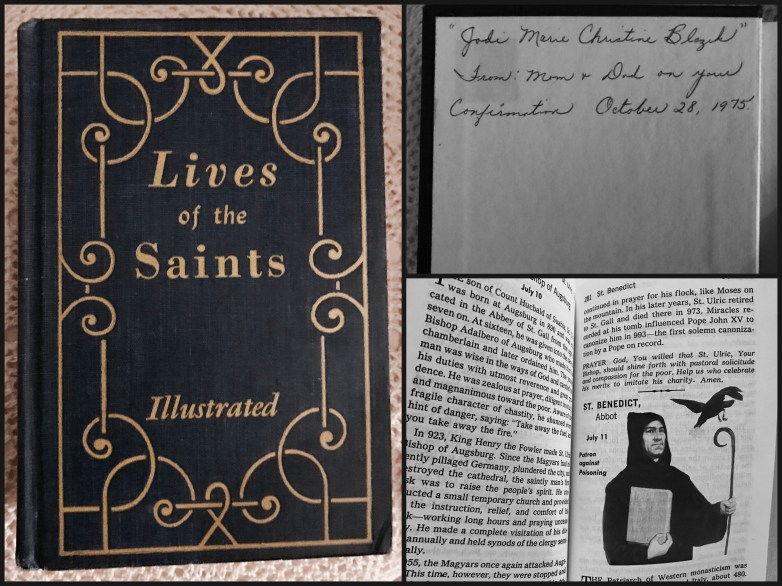
My grandma was so proud of my Confirmation that she called me Christine the whole day. My parents gave me an illustrated book of the “Lives of the Saints” to commemorate the occasion and as any nine-year-old would do, the first thing I did was look up my birthday. I was immediately disappointed. The illustration seemed so dark –a man with a hood, a scary looking bird and a funny name that I had only associated with Benedict Arnold, a famous American traitor.  After gaining such a beautiful name like Christine, what kind of luck did I have to get a guy named Benedict on my birthday?!  July 11, St. Benedict, Abbot, it said.  I read the pages about St. Benedict often, thinking that I should have some connection with this man as my patron saint, but then I forgot about him until…

confirmation

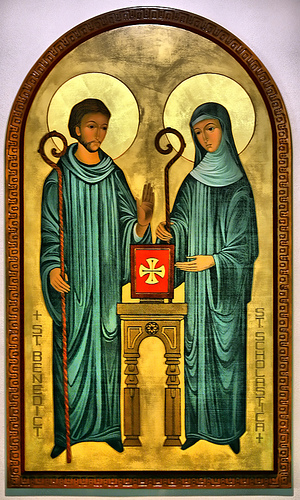
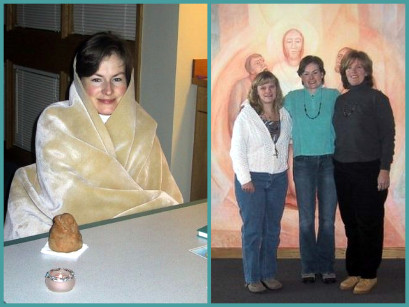
Fast forward 30 years when I found my way to St. Benedict Center, not because of the name or that I remembered anything that I had read about St. Benedict, but because I had a desire for prayer and silence. And at a silent retreat, I met a woman named Colleen who would become like a sister to me, an Anam Cara or soul friend. She gave me a card once that said, “We’re like sisters with different mothers.” We connected on a spiritual level–we prayed together, read spiritual books and could have talked for hours about our spiritual journey. And what I discovered the year she passed away further deepens our connection. Her birthday is February 10 and her patron saint is St. Benedict’s twin sister, St. Scholastica. They had a close relationship, even though they could not spend a lot of time together, and they were both committed to God. 

Here is the story of St. Scholastica from the books of Dialogues by Saint Gregory the Great: 

“Scholastica, the sister of Saint Benedict, had been consecrated to God from her earliest years. She was accustomed to visiting her brother once a year. He would come down to meet her at a place on the monastery property, not far outside the gate.

One day she came as usual and her saintly brother went with some of his disciples; they spent the whole day praising God and talking of sacred things. As night fell they had supper together.

Their spiritual conversation went on and the hour grew late. The holy nun said to her brother: “Please do not leave me tonight; let us go on until morning talking about the delights of the spiritual life.” “Sister,” he replied, “what are you saying? I simply cannot stay outside my cell.”

When she heard her brother refuse her request, the holy woman joined her hands on the table, laid her head on them and began to pray. As she0035 raised her head from the table, there were such brilliant flashes of lightning, such great peals of thunder and such a heavy downpour of rain that neither Benedict nor his brethren could stir across the threshold of the place where they had been seated. Sadly he began to complain: “May God forgive you, sister. What have you done?” “Well,” she answered, “I asked you and you would not listen; so I asked my God and he did listen. So now go off, if you can, leave me and return to your monastery.” 
Reluctant as he was to stay of his own will, he remained against his will. So it came about that they stayed awake the whole night, engrossed in their conversation about the spiritual life.

It is not surprising that she was more effective than he, since as John says, God is love, it was absolutely right that she could do more, as she loved more.

Three days later, Benedict was in his cell. Looking up to the sky, he saw his sister’s soul leave her body in the form of a dove, and fly up to the secret places of heaven. Rejoicing in her great glory, he thanked almighty God with hymns and words of praise. He then sent his brethren to bring her body to the monastery and lay it in the tomb he had prepared for himself.

Their minds had always been united in God; their bodies were to share a common grave.”

The lessons I’ve learned from St. Benedict and St. Scholastica, from my friendship with Colleen and other soul friends, are many. I’m sure there are more to come, but here is some of what I’ve learned so far:

Spiritual friendships never end.  ♥  Neither death nor distance can separate us from the love of another.  ♥  There is no such thing as loving too much.  ♥  Spiritual friendships are a gift from God.  ♥   We support each other in living out God’s purpose in our life.   ♥   Spiritual connections with friends enrich one’s prayer life and guide the other back to God when one is temporarily lost.   ♥   Spending time together is important, but friendship resides in the heart.   ♥   We pray for and with each other.   ♥  We cry with each other.   ♥  We laugh together.   ♥  We listen to, plan with, comfort and challenge each other.   ♥  We are grateful for each other and we say it.   ♥  “Our minds are united in God.”

I thank God for the example of all the saints and for learning about St. Benedict as a child. I thank God for my oblate experience to learn more about St. Benedict and his Rule (and about the hooded Abbot and his scary bird). I thank God for the lives and stories of St. Benedict and St. Scholastica. I thank God for spiritual friendships

Joyce, Colleen and me at St. Benedict Center.

 “Friendship is the linking of spirits.  It is a spiritual act, not a social one.  It is the finding of the remainder of the self.  It is knowing a person before you even meet them.”  ~Joan Chittister

For more information about Benedictine Spirituality, go to Being Benedictine website/blog

An ICY snow day reflection

dsc_0835a

Last week I enjoyed the stability of an icy day. The Benedictine vow of stability provides for our need to be rooted in Christ, to be grounded in the present moment, and practicing gratitude regardless of our circumstances and of the uncertain future.  Seasons come and go, “but the word of our God stands forever.” (Isaiah 40:8) We learn from the seasons that they and all things do, indeed, pass. The icy, chilly weather prevents us from traveling too swiftly; there is something to learn from this staying put. This paradox, that we must stay grounded during the changing seasons, encourages us to move a little slower and to learn from the present moment. The icy weather gives us no choice but to stay put. Perhaps when we are going through “icy” relationships or experiences, we can apply the Benedictine principle of stability.  Continue reading “An ICY snow day reflection”

The road ahead is uncertain. But isn’t it always?

The road ahead is uncertain. But isn’t it always?

Today’s weather, on this day of the inauguration, reflects how I have felt for several weeks now. It’s a little dreary, foggy, rainy; the road ahead is unclear.  But weather can change quickly in Nebraska, so I imagine that my feelings will likely change soon enough as well. There’s also a good chance that even if circumstances stay the same, how I see them will change. One day it won’t seem so foggy and dreary. I know this is true, both for the weather and for myself.

fullsizerender-29

Earlier this week I posted photos of the ice storm that created such dangerous conditions, closing schools and businesses for a few days; today there is haze and drizzle; and, tomorrow it’s supposed to be 50 degrees. Only in the state of Nebraska can we experience so many seasons in one week! As for my state of mind, foggy actually feels pretty good compared to the earthquake, tsunami-sized feelings that came on the heels of a simultaneously frigid and fiery election season.  But I know that how I felt November 8 is different than it was a month, a week, or even a few days ago. Continue reading “The road ahead is uncertain. But isn’t it always?”

Blog at WordPress.com.

Up ↑