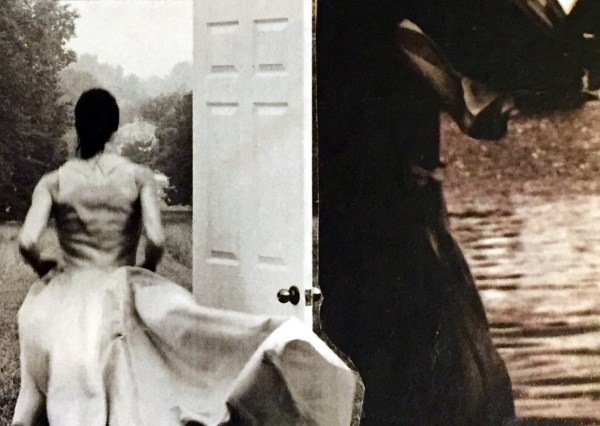
“…the doors to the world of Wild Woman are few but precious. If you have a deep scar, that is a door, if you have an old, old story, that is a door. If you love the sky and the water so much you almost cannot bear it, that is a door. If you yearn for a deeper life a full life, a sane life, that is a door.” –Clarissa Pinkola Estes, Women Who Run With the Wolves
I am one who is Witness to self.
I am one who stands tall
Upright, resilient, longsuffering
Despite winds of change.
I am one who, with the pace of a praying monk,
Glides gently through breeze and shadow, clouds and sea.
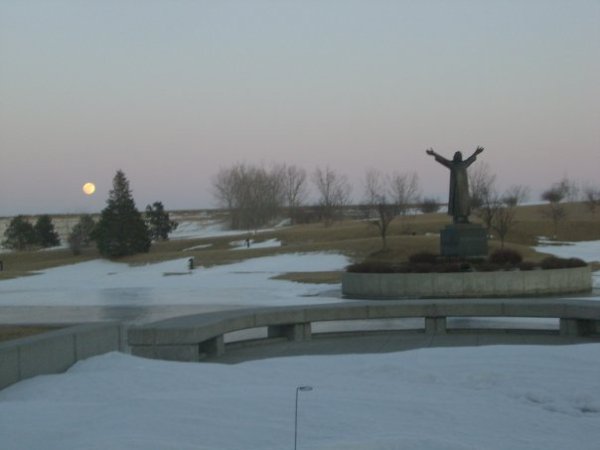
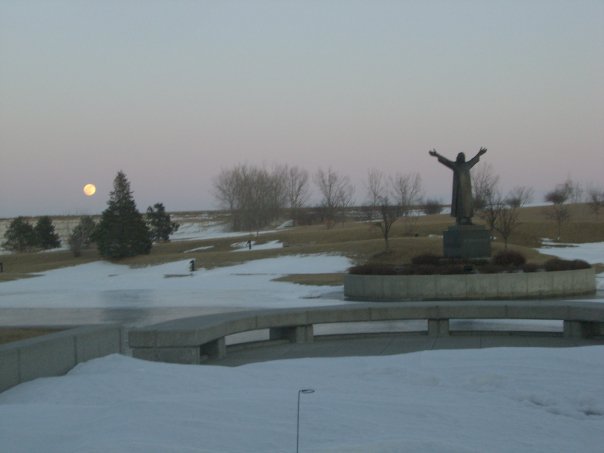
Dear Super Blue Full Moon behind the clouds, I know you are there even when I can’t see you, just like my loved ones who have passed on.
On this night of the Super Blue Full Moon (that I am sure is happening behind the clouds), I am reminded of a very special Full Moon experience eight years ago (thanks to Facebook memories…how else would I remember?)
Eight years ago tonight, a six-year vision came full circle when my friend, Joyce, and I facilitated a retreat for some special friends. It was a dream we had from the beginning. We wanted to create a safe place for women to share their spiritual journey—we called it our Circle. We wanted to reach out to other women, to share our passion for seeking God and experiencing the Divine in our everyday life.
It didn’t happen quite the way we expected. Our friend, Colleen, was a part of our journey as well. But Colleen had some demons that we were unaware of. When she took her life, we wondered—what kind of spiritual support group are we? How could this happen? How could our spiritual, compassionate, beautiful friend not want to continue this journey?
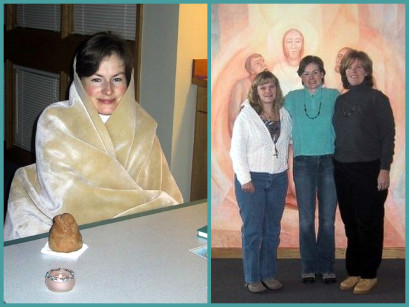
Joyce, Colleen and me at St. Benedict Center.
This, too, was part of our spiritual journey—the grief, questions, doubt, hurt, anger. But we shared it all together. When we came out the other end of healing (if that is really even possible), we knew we needed to have the retreat that we had all envisioned.
After several years, we did. I am grateful for the women who joined us on the journey— on that first retreat and also as part of our Circle that still meets monthly.
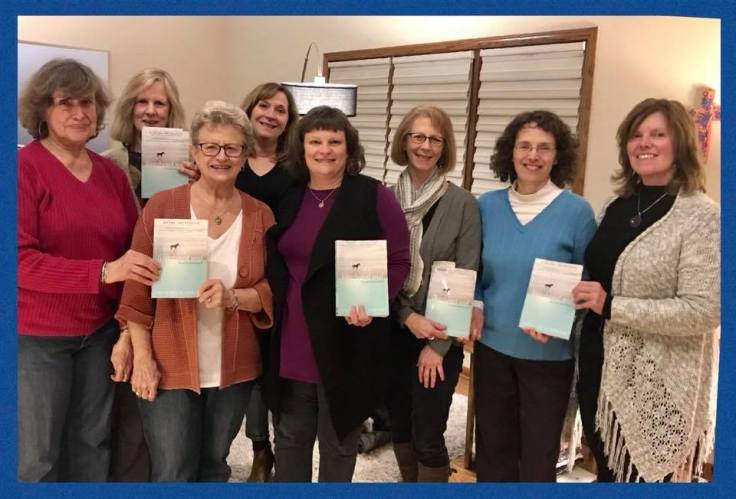
Our Circle–January 2018–we read The Untethered Soul by Michael A. Singer
I’ve continued to lead retreats using the name SoulFully You. It’s been such a gift to introduce others to the many ways to pray, especially using creativity and the power of images through the SoulCollage® process.
“When we embrace our creative spirits and learn to express ourselves creatively, we feel inspired and alive. Creative and passionate expression is essential to the feminine soul. Sometimes our creative fires get turned down, burn a little low, and even smolder, but the sparks can be rekindled and ignited.”— Moon Mother, Moon Daughter Janet Lucy and Terri Allison
I thank God for the sparks in my life, my Circle, my friends. My eternal gratitude belongs to Colleen, whose idea it was in the first place to start a Circle. Her spirit lives on. We are a Circle that has no end.
“Friendship is the linking of spirits. It is a spiritual act, not a social one. It is the finding of the remainder of the self. It is knowing a person before you even meet them. I am not so sure, then, that we so much find a friend as it is that friendship, the deathless search of the soul for itself, finds us.” The Friendship of Women, Joan Chittister
Dear Super Blue Full Moon behind the clouds, I know you are there even when I can’t see you, just like my loved ones who have passed on.
There are layers of history in Rome—“layers like lasagna”—one tour guide suggested. Literally, layers were built on top of layers, buildings that had been destroyed by war and natural disaster were covered with dirt and new buildings were erected over ruins. Symbolically, many Christian churches were built over ancient pagan sites.
The architecture, art, and religious history communicate something spiritual, a deeper story with layers of meaning, like lasagna. I’ll share some of my favorite places, and the journey, from my trip to Rome to attend the World Congress of Benedictine Oblates:
St. Peter’s Basilica and the Scavi tour
On my first morning in Rome, I had scheduled a visit to St. Peter’s Basilica and the Scavi tour of the necropolis beneath, including St. Peter’s tomb. My plan was to have a taxi drop me off where I needed to be to start the tour for a stress-free morning, no need for coat and umbrella, and no need to hurry. Where I thought I could find a taxi, there were none; where a distracted police officer pointed, there were none. A little nervous, I decided I should just start walking in the general direction of the Vatican or I may not get there in time. Surely, I would see the large dome and signs along the way. There were none.
This slideshow requires JavaScript.
I remember that the Vatican was just to the left of the Tiber River as it changes directions. With this vague idea, I set off on a lovely tree-lined path along the Tiber River. The views were beautiful—this will be just fine, I say to myself, I have plenty of time.Getting a little chilly, but I’ll be there soon. The online map said a 45-minute walk. Oops, a few sprinkles, a few more. Darn it, why didn’t I bring the umbrella I had packed?
I reach the point where the Vatican should be but I see no less than six different options to take; I see no dome and no signs. In panic mode now, with it getting colder and sprinkling more, I ask a woman, “Where is the Vatican?” Mind you, I had asked one young couple who responded, “In hurry, no time” and another woman who circled herself saying, “hmmm” whom I decided not to trust for accurate directions, but this woman—she is my angel. “No English. I take you,” she said. Oh, thank God.
She takes me a few blocks to the intersection where I finally see St. Peter’s Basilica (and its dome. Who knew the Vatican was surrounded by other tall buildings? Not what I had pictured.) I have finally arrived, yet I still need to walk several blocks in light rainfall, so I duck into a little storefront outside of St. Peter’s Square and buy an umbrella. Better safe, than sorry, I think.
Thirty seconds later, new umbrella overhead, I experienced the hardest rainfall I’ve ever walked in (outside of the time I got lost in Munich, Germany …. hmmm, seems to be an international pattern). I arrive at the gate of the Swiss Guard in plenty of time to stand in the cold and rain for at least 30 more minutes before the tour began. Still, I am grateful I walked. I learned, and saw, much more than I would have had I been delivered directly to St. Peter’s Square. There are layers of meaning when you surrender to the journey.
The tour was quite amazing, but I was most struck by the case the guide built throughout the tour that the Basilica was indeed constructed over St. Peter’s tomb. The area beneath St. Peter’s Basilica was only discovered in the 1940s and during excavation, archaeologists found a 4th-century burial ground and a grave marked with ancient lettering translated, “Peter is here”. I was so touched by the reverence our guide showed letting each individual participant have a few moments to privately view the site. It was a moment for the heart to remember only; no photos were permitted on the tour. Nearby the guide pointed out an elaborate grate in the ceiling—directly above, one could hear the prayers and responses of a Mass in progress in the Basilica. For centuries, what laid below was hidden. This faith, built on a grave, has layers of meaning, like lasagna.
I had plenty of time to explore the Basilica and its side chapels in quiet solitude when I went on my own, but on the World Congress of Benedictine Oblates group tour we learned some of the symbolism behind the artwork, altars, and relics from a guide. I learned the bronze statue of St. Peter holding the keys of heaven was a pilgrimage itself—for centuries pilgrims touched or kissed his right foot, literally wearing it thin, to receive a blessing from the Church’s first Pope, hoping the gates of heaven would be opened for them. This Catholic faith holds so many beautiful rituals with layers of meaning. Layers, like lasagna.
Aventine Hill, One of the Seven Hills of Rome
Before going to the conference center, I stayed two nights at a monastery at the bottom of Aventine Hill, chosen to be near Sant’Anselmo all’Aventino, the monastery of Fr. Mauritius Wilde. Located in a surprisingly residential area near the Coliseum, I favored the solitude and quiet of the crooked, narrow street lined with gardens, parks and ancient churches to the bustle and crowds of St. Peter’s Basilica.
On the leisurely journey up the hill to visit Fr. Mauritius, I visited the Basilica of Santa Sabina, the oldest Roman Basilica built between 422 and 432, where Pope Francis celebrated Ash Wednesday. Traditionally, the Pope begins the celebration at Sant’ Anselmo’s, walking on foot from one basilica to another, to celebrate the beginning of Lent. Further up the hill, I visited Santi Bonifacio and Santa Prisca, as well as a park that overlooked the center of Rome, and the famous Knights of Malta Keyhole that outlines a view of St. Peter’s perfectly.
It was a delight to see Fr. Mauritius, who moved to Rome after serving as Prior for six years at Schuyler’s Christ the King Priory. After a behind-the-scenes tour of the academic center, monastery, chapel and grounds, we enjoyed conversation on the patio. I had kept in touch with Fr. Mauritius since his move the year before, but this revealed another layer, like lasagna. There is a contentment knowing just where my friend’s home is, to know where he works and prays.
This slideshow requires JavaScript.
St. Benedict’s cell at San Benedetto and Montecassino Abbey
Both destinations were a highlight of sacred sites visited—first, the cell of St. Benedict while he studied in Rome (about the year 500) before founding his first monastery in Subiaco. The cell, or small room, has been preserved; a small chapel adjacent, San Benedetto in Piscinula, dates back to the 12th century. I loved, LOVED, loved this special place. I could have stayed there for hours. To know that St. Benedict listened “with the ear of his heart” in this very place, rejecting the political corruption of Rome and what was expected of him, to pursue the call he knew was from God—well, for a Benedictine Oblate, this is a moment. Had I not been in a group with a full sight-seeing schedule, I would have likely spent a half-day in contemplation at this chapel.
After a beautiful drive in the countryside east of Rome, we arrived at the Abbey of Montecassino where St. Benedict wrote his Rule. We were welcomed, after a foggy drive up the mountain, by clear skies and a heartfelt blessing at Mass—“This is your house as Benedictines,” the priest said, “St. Benedict welcomes you, hugs you, blesses you.” After Mass, we visited the original part of the Abbey, dating back to the 5th century, which had not been destroyed during World War II. This was another profound experience—to be in the place where the Rule of St. Benedict, a guide for monastics and oblates for over 1500 years, was penned. Later we met a gentleman who, as a little boy, had taken refuge with his family at the Abbey during the War, hoping to be safe with the monks high on the mountain. How devastating war is, how many layers there are—for this young boy and his family, the nearby town and, ultimately, the Abbey, bombed in the Battle of Monte Cassino. There are no winners in war.
This slideshow requires JavaScript.
Place is a powerful thing
It gives us perspective, a sense of where we’ve come from and how we’ve gotten here. The Christian story unfolded in this place of Rome. I am so grateful to have experienced this place of Peter and Paul, the places of St. Benedict and so many other holy places.
But I remember that home is holy too.
Home is where I work out the tension between stability and conversion. Home is where I listen to the ear of my heart. Home is the most important place; it is our present moment. Home is the people you surround yourself with, our friends and family. Our story unfolds at home. This is where we uncover our many layers, like lasagna.
Hmmm, I think. “Good question…yes, because of faith and hope. Many blessings.”
This might not be the typical are-you-okay-what’s-wrong? line of questioning one might expect, but good friends know what’s behind your “yes and no” already. Sometimes the no just needs to lie right where it is; it’s the yes that needs more attention.
Likely, the question was meant for me to consider what is good? what is hopeful? what is well with my soul?
A few days ago, I created a SoulCollage® card, that I named “The Seasons of Life: I’ve Seen A Lot of Shit.” Eloquent, I know, but it’s the first thing that came to mind when I looked at my finished card.
I had no idea what I was creating when I started, with no goal in mind. I was drawn to the older women sharing stories and enjoying each other’s company. They look experienced (not old, please), rested, peaceful, connected, comfortable and wise. I imagined what it was they might be discussing. Perhaps the storms of life, the many changes they had experienced, their efforts to rise or reach or resist, obstacles they had overcome, obstacles that made them feel all shot-up and yet, in the end, still standing, still sitting, still connecting, still enjoying.
Both women hold a little of each season, every year, and the many experiences they have lived within them.
“Autumn holds fragments of the other seasons in transformative arms…the mood of autumn is the ebb and flow of life. Autumn stands as an epiphany to the truth that all things are passing and even in the passing there is beauty. It holds out platters of death and life.” -The Circle of Life, Joyce Rupp & Macrina Wiederkehr
Each of us is called to take the seasons of life into “transformative arms”, to become more of who we are. So this autumn weekend, I consider the seasons of life—all of it, especially the blessings. I think about the “yes” of life that threads itself through my days—the yes to faith, hope and gratitude for many blessings. The daily yeses keep me focused on the bigger yes—the yes to God.
My yes is the desire to become more of who God created me to be. This I have hope for and believe in. This I am grateful for and what I say yes to.
Yes, it is well with my soul.
“People often speak of becoming more grateful after having lost some of their health. Suddenly they see all they have taken for granted. Gratitude for all that has been enables them to say yes to all that is to come.” -The Circle of Life, Joyce Rupp & Macrina Wiederkehr
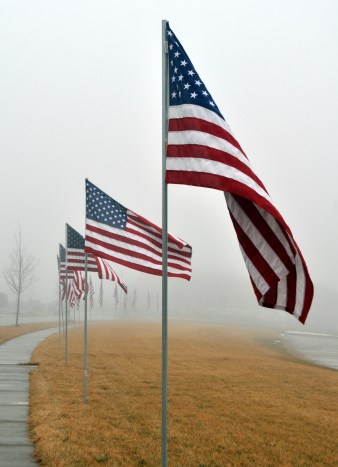
Each school day during my 3rd-period Marketing class, I stand with my students, hand over heart, pledging allegiance to the Flag of the United States of America and to the Republic for which it stands, one Nation under God, indivisible, with liberty and justice for all.
This simple moment of national patriotism is a requirement in Nebraska, a rule passed by the Nebraska Board of Education in 2012 stating that all public schools must provide time every day to recite the Pledge of Allegiance in order to receive accreditation or state funding. Already a common practice in elementary schools and many districts, it was a new practice for most high school students.
After the rule passed, teachers took an inventory of classrooms that needed flags—many were old and torn, more had been discarded over the years and with tight budgets, new ones hadn’t been purchased. The first several weeks, hand over heart, we stood facing an 8 ½ x 11 colored photocopy of the flag until a generous alumni donated enough American flags for every classroom.
Reciting the pledge is voluntary for students and teachers. We can recite the pledge either standing or sitting or remain quiet showing respect for those who do participate. After five years, I am still surprised when there are a few students that don’t stand to say the pledge. I’ve wondered why. This semester every student stands.
Regardless of our different political views or opinions, it feels like the one great gesture we can make together is agreeing to pledge allegiance to the flag. We have so many other opportunities, especially this past year, to take a stand (or sit), to disagree, to voice an opinion, to protest or resist. But I’ve also come to the conclusion, and I respect, that not everyone feels the same and that perhaps they have good reasons for not standing or reciting the pledge (besides it’s their constitutional right). In the words of Pope Francis, who am I to judge?
For a few years, I showed a short video clip with Red Skelton explaining what each line of the Pledge meant to him (if you are old enough to know who he is, likely you stand without question for the Pledge of Allegiance). Maybe I’m old-fashioned, but I will continue to stand in spite of my disappointment, even shame, at what has become of our United States. I have faith in the words of our Pledge and faith in the meaning behind the words.
As I say the Pledge, I take the time to breathe, slow down and really think about the words I’m saying. I hope and pray that my country will live up to the words that each day we profess. There are far too many days lately when I’m uncertain what America really stands for, but when I say the words of the Pledge of Allegiance, it is this in which I believe:
I PLEDGE ALLEGIANCE, promising to speak my truth while remaining committed, TO THE FLAG as a symbol OF THE UNITED STATES OF AMERICA. I pray, even when we seem so divided, that we are united in, and take seriously, our responsibility to all people within and beyond our borders, especially those who flee their own country seeking a place of peace and promise. I hope we are not so proud of our country that we forget about others, that our desire for unity does not become exclusion.
AND TO THE REPUBLIC FOR WHICH IT STANDS, a country that is a worthy and wonderful place to live, grow and be, representing a land of opportunity and a chance to always begin again.
ONE NATION that represents a diversity of opinions, beliefs, ethnicities, lifestyles, socioeconomic and educational groups, yet a nation that comes together and is unified in times of tragedy and trial;
UNDER GOD, through our faith, hope, and prayer, in the spirit of our founding fathers and mothers, guided by a morality that resides within;
INDIVISIBLE, without division, united with wholeheartedness of spirit;
WITH LIBERTY AND JUSTICE, in gratitude for our freedom, with a duty to be fair and honest, and respectful of all we encounter.
FOR ALL. In God’s eyes, there are no borders—we breathe the same air as the refugee, immigrant, gay, straight or transgendered, Muslim, Hindu or Christian, Republican or Democrat, liberal or conservative, Protestant or Catholic. We breathe the same air as those we disagree with and those we live with. We are one world. Oceans cannot be divided, this part belonging to Europe and that part belonging to America. The air cannot be split—Mexico breathing this air and America breathing that. No, we breathe the same air. We are connected to all people, all countries. All means all.
This I pledge. This I stand up for. This I place hand over heart for and recite every day of the school year. This I pray.
Our words matter, so how can we live what we profess and believe, as individuals and as a country? Each of us must reflect on what it is that we place hand over heart and stand up for.
“I pledge allegiance to the Flag of the United States of America, and to the Republic for which it stands, one Nation under God, indivisible, with liberty and justice for all.”
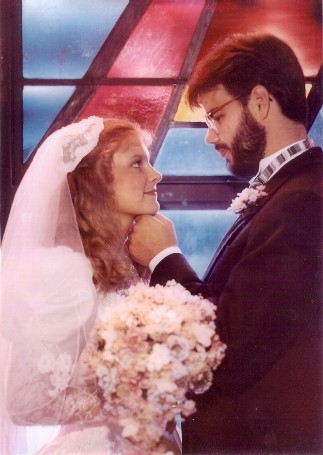
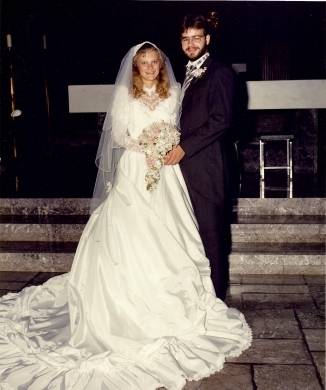
A marriage is made of moments. When you string them all together, you get a picture of a life built together. A marriage isn’t made, once and for all, when the I-dos are exchanged. A marriage is constantly being recreated; it is always in the process of becoming.
A marriage goes through seasons: the spring of new life and hope, the summer of comfort and security, the autumn of changes and letting go, the winter of sadness and despair. A marriage will not survive without adapting to, enduring and celebrating the change of seasons. A marriage embraces all seasons.
I believe more each day that it is only in the stability of marriage, enduring the weather of every season, that one can reap the true benefits of a life lived together. Advice to young couples: Stick with it. Don’t give up. I promise, with effort, love, respect, and forgiveness, your marriage will endure and you will be so happy it did!
A marriage is made of moments.
Marriage includes the necessary and mundane—doing laundry, taking out the trash, paying bills, fixing, washing, mowing, checking things off the list of things to do, arguing about checking things off, thanking each other for checking things off.
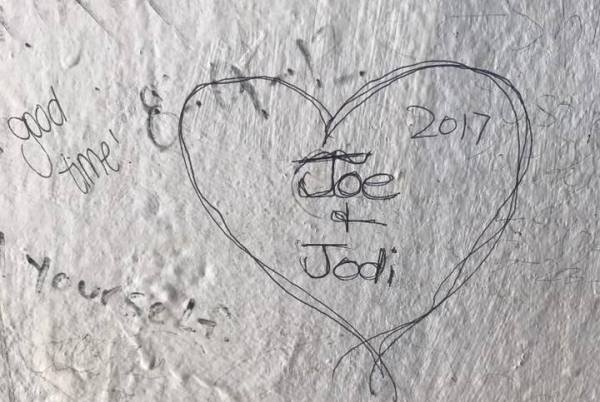
After 32 years of marriage, Joe and I have so many “remember when” moments, the makings of great storytelling or one-liners that no one else understands but us. Funny, sad, silly, stupid, poignant, heartwarming, memorable moments. Moments we’d like to forget and moments we have to forgive. But, mostly, moments that have helped us become who we are.
A marriage is made of moments. Some of our earlier moments:
Joe sending little gifts to me for several days before our wedding that said: “7 days til a lifetime” (6, 5, 4 and so on). Each day a new gift arrived.
Working four jobs between us so I could finish college, sometimes with only enough time to exchange notes or take a break together at one of our shared part-time jobs at Montgomery Ward.
Buying our first home and meeting our neighbors, Cece and Bob. Cece, who became a widow just six months later, became part of our family and a grandma to our daughter.
Having our first baby and Joe announcing “You got your girl!”, when she was born…my secret hope.
Experiencing the loss of two babies and the grief of infertility while creating a family of three with more love than we could imagine.
Welcoming dogs (Ralph, Rosie, and Bailey) and cats (Peaches and Boots) into our little family…and missing their love and companionship when they passed on.
Being parents to Jessica, from diapers and bottles, soccer games and DECA competitions to college internships and sorority activities.
A marriage is made of moments. Our life now:
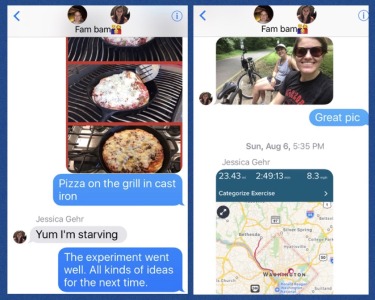
Being empty nest parents to Jessica, staying in touch with our daily Fam-bam texts. Everything from biking routes that Jessica and a friend took to pizza Joe and I made in a cast-iron skillet to a virtual shoulder to cry on during some rough patches. We are a family connected wherever we are.
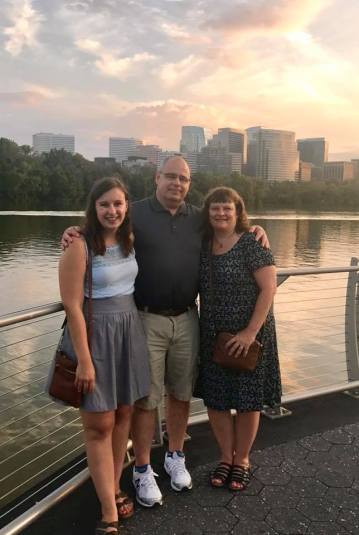
Visiting Jessica at her home in Washington DC, letting her host us and be our tour guide. (Of course, we still pick up the check at all the restaurants she has been dying to visit.)
Enjoying what still feels like our new home, getting into jammies the minute we get home from work, making dinner, yelling at the news (rather than at each other) and thanking God that we have grown together, sharing the same world view in very troubled times.
Providing comfort, support and unconditional love for each other (and Jessica) during some very challenging and painful experiences this past year.
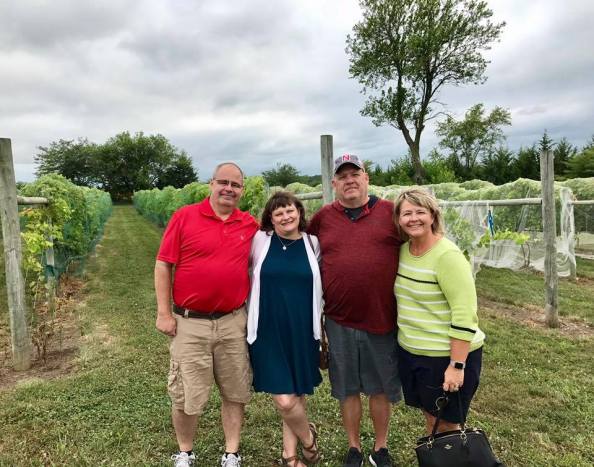
With the Schoenings, friends we met Jessica’s kindergarten year. Just like family!
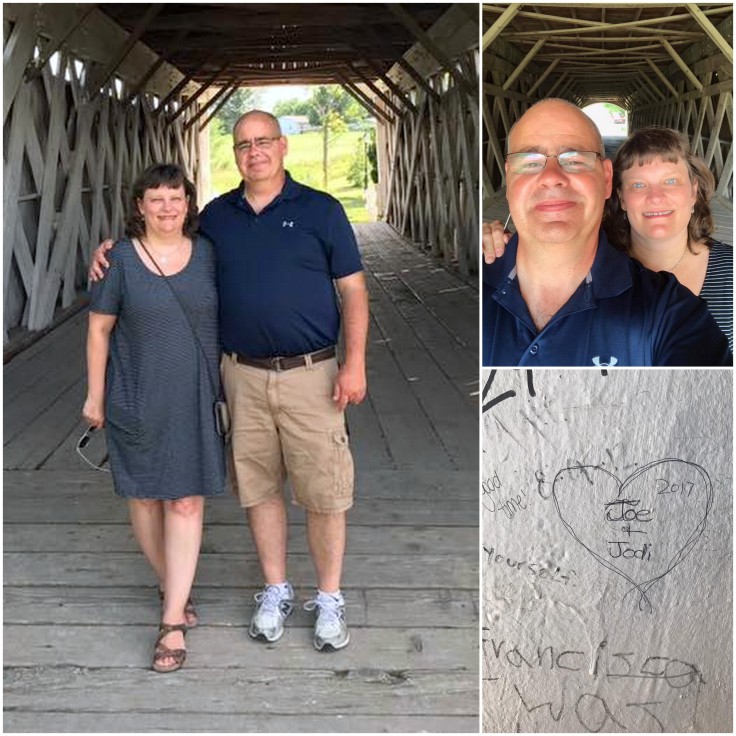
Becoming more adventurous as empty nest parents: enjoying fun times with friends, day trips to nearby wineries, and taking a special trip to the Bridges of Madison County just the two of us.
Thirty-two years of marriage is a threading of memories, a string of moments that hold the seasons of life. After 32 years, marriage is about acceptance. We rest into acceptance of who the other is, rather than attempting to create the other into who we would like them to be. We enjoy each other with a lightheartedness that wasn’t possible in the newlywed years. Time is funny: it goes too fast, but it also unfolds so slowly that we don’t always see the transformation of the innocent into the mature, the immature into the confident. After 32 years, I know that this man is someone I can count on no matter what the season. I am so grateful for our marriage and our beautiful grown-up girl!
Happy 32nd Anniversary to us!
A Marriage Made of Moments is a blog post I wrote for our 30th anniversary in 2015. For our 31-derful anniversary, I shared a revised post with updated photos, new “moments” and fresh reflections. Check them out too. ❤
There could be many titles to this blog post—
God Does Much And Asks So Little,
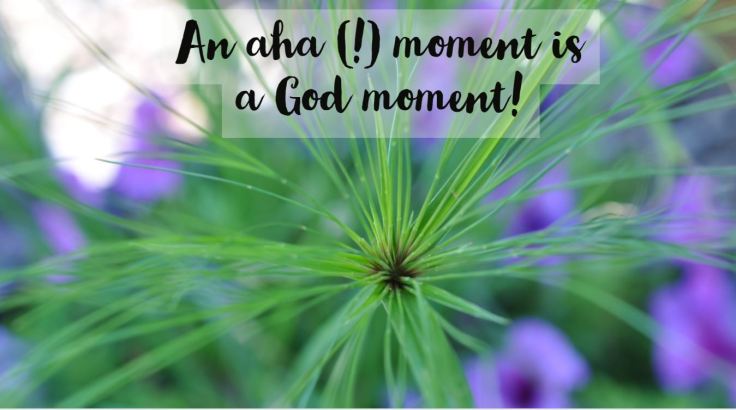
Aha (!) Moments are God Moments,
God is in Control,
Queen of Procrastination
Yup, that’s me, queen of procrastination. It probably doesn’t matter what the title is, but I will likely spend as much time considering the title as writing this post. I have to get back to my studies so, of course, this is a perfect time for the cloud of procrastination to cover all reasonable attempts to get something done.
But I had an aha (!) moment and I have to capture it. Technically, it’s two aha (!) moments that converge, but anyway, here goes—a creative attempt at procrastination cloaked in inspired productivity.
The past several days I have read all four Gospels of the New Testament—Matthew, Mark, Luke, AND John. And not just the miracles or the well-known parables, but from beginning to end; every chapter, every verse. And for each of the Gospels, I’ve also read a chapter in my textbook, The New Testament by Stephen L. Harris, for a class I’m taking at Creighton University. Each chapter comments on key topics, themes, author, date and place of composition, various sources used, the intended audience and interpretations.
I don’t have the words yet for all that I’ve learned, but that’s also why I’m procrastinating. I need to find some words (very soon) to write an 1800 word paper, due in 48 hours, responding to this prompt: Explain the story of the life of Jesus as portrayed in the Gospel of John, and compare it to either Matthew or Luke and how this might relate to ministry today.
I trust the words will come, but this first. Here goes….
Surprisingly (to me) each of the four Gospels share a unique portrayal of Jesus, his life, death, resurrection, and ultimate purpose of all of the above. Ninety percent of the content in the Gospel of John is not in the other three synoptic Gospels. Who knew?
It’s hard to capture the diversity of the Gospels with just daily readings and/or what one hears on Sunday mornings. The Jesus that is portrayed in the Gospel of John parallels some of the Wisdom speeches in the Hebrew Bible.
This is where the aha (!) moment comes in. As I read through the selections from Proverbs, Ecclesiastes and the Wisdom of Solomon, I am overwhelmed by how much Wisdom, the Spirit of God, does for me:
Wisdom searches the streets for those willing to receive her. ~ Wisdom lifts her voice, cries out, stands at the crossroads, calls, appeals, speaks clearly, bestows, shows the way, fashions, plays, delights, covers, decrees, remains, takes root among the people, loves what is good and guides. ~ Wisdom has ability, understanding, power. ~ Wisdom makes all things new, enters into holy souls and labors at our side. ~ Wisdom is intelligent, holy, unique, made up of many parts, subtle, free-moving, lucid, spotless, clear, invulnerable, kindly towards men, all-powerful, all-surveying. ~ Wisdom is the brightness that streams from everlasting light, the flawless mirror of the active power of God and the image of his goodness. ~ Wisdom permeates all intelligent, pure and delicate spirits.
And this is what Wisdom desires from me:
Listen! Love me. Search me. Keep my ways. Come to me. Eat your fill of my fruit. Feed on me. Drink from me.
Wow. God does so much for me. And asks so little.
While on retreat this summer, the spiritual director that I met with daily asked me to reflect on what God is responsible for or in control of versus what I am responsible for or in control of. As I reflected on each of my thoughts and actions throughout the day, I created this list:
At the end of the day, it was apparent to me that very little is in my control and that very much comes from God.
God, or Spirit, is the very breath of life. I am always and forever dependent on the gift of each moment. And I am always and forever responsible for my reaction to this great gift.
God is the creator and great mover of all. My response to this is to be authentic, prayerful, grateful, committed, attentive, and discerning. I am responsible for my actions, thoughts, and response to God and others.
I am not in control and never have been. If ever things felt “under control” or to my liking, it was just the way it happened to be, not because I had commanded it. It is a freedom to know that I don’t cause order or chaos. My role, what I am called to do, is to listen to, search for and follow God. The Spirit of God proclaims, “Those who love me I love, and those who search for me find me .” -Proverbs 8:17
God does so much and asks so little.
“Wisdom is both the means by which God creates and the channel through whom he communicates to humankind.” -The New Testament, Stephen L. Harris
Note: This post is about 800 words so I’m hopeful that I can crank this paper out in a few days.
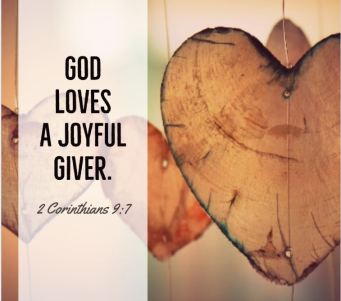
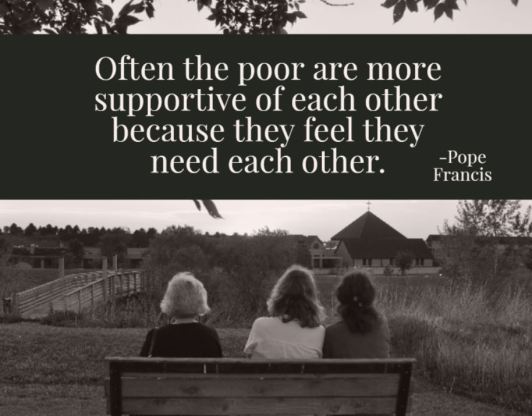
People who don’t give money to the homeless because they think it will be spent on alcohol and not food should ask themselves what guilty pleasures they are secretly spending money on, Pope Francis said. “There are many excuses” to justify why one doesn’t lend a hand when asked by a person begging on the street. (Carol Glatz, Catholic News Service, 2/28/17)
I’ve been thinking about the decision to give (or not to give) to a beggar on the street since Pope Francis suggested that giving “is always right,” whether one thinks the other is truly in need or not. A few months ago when I was leaving a movie theater, having spent an evening out with friends, I saw a homeless man with a sign asking for money. Engaged in conversation, I quickly walked passed him. I was pretty sure I didn’t have any cash on me anyway. But later, upon reflection, I realized that I did not (or could not) look the man in the eye, and I wondered why. If I had money with me, would I have given it to him? Would I have looked him in the eye then? I felt a sense of shame, partly for not giving him some money, but more so because I hadn’t looked at him directly. Looking someone in the eye honors their dignity; it acknowledges WHO THEY ARE.
I have considered more that “tossing money and not looking in (their) eyes is not a Christian” way of behaving, either. Pope Francis suggests the way one reaches out to the person asking for help is important and must be done “by looking them in the eyes and touching their hands.” It honors the dignity of the other, regardless of whether we feel the other is deserving. In this way, we face our own judgments of another, our implicit bias.
When encountering people who live on the street, the pope said he always greets them and sometimes inquires about their lives and background. He always chatted with a homeless family and couple that lived next to the archbishop’s residence in Buenos Aires, Argentina, he said, and never considered getting rid of them. When “Someone told me, ‘They’re making the chancery filthy,’ Well, the filth is within” one’s heart, he said. (Carol Glatz, Catholic News Service, 2/28/17)
Several days after walking by that beggar, my husband and I encountered the same scene, a homeless man with a sign asking for money. As we walked by, not looking at him directly, I paused. We had a quick discussion about giving some money or not, and I remembered Pope Francis’ advice: It is not my job to determine whether this man is truly in need or to be concerned about where the money shall be spent. And it’s not even about whether I can afford a dollar or two, of which I am quite able. If I can’t spare a dollar after having a lovely dinner on the way to a concert, then it says more about me than the beggar. Continue reading “God Loves a Cheerful Giver”→
There are many ways to pray. Really all of life can, and should, be a prayer. We are never not in connectedness with God, but it is in prayer that we become aware of this union even more.
Recently, I shared an experience of walking a labyrinth, an ancient portal to prayer that has only one distinct path on which to walk; it is not a maze as some misunderstand it. A maze typically has just one correct path, but it has many confusing choices and dead ends that lead to nowhere obliging one to make a decision about which path to take. One may have to “begin again” several times before completing.
St. Benedict, in his Rule, encourages his monks to always begin again. He knew there would be times when life, even our prayer life, could be more like a maze than a labyrinth. Despite its challenges, our maze-like experiences are a prayerful opportunity to practice awareness, patience, and gratitude.
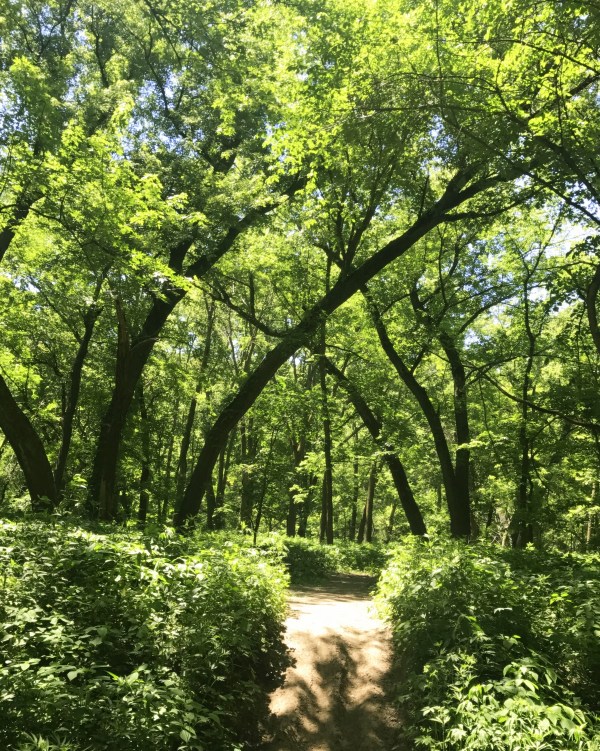
I had this opportunity recently. Surrounded by the wooded hills of western Iowa at the Creighton University Retreat Center, I attended an eight-day silent Ignatian retreat.I was excited to take the loop hike that goes down to the Nishnabotna River. I love to be in nature and believe wholeheartedly, that “every time you admire something in nature, it’s a prayer to the Creator.” (Vernon Harper)
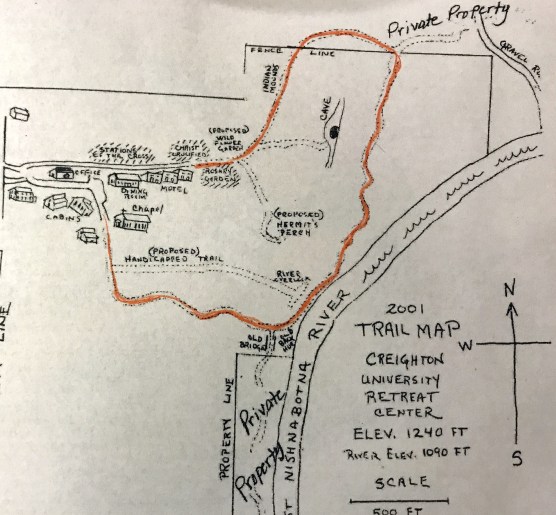
Note the easy-to-read map:one can enter the loop hike from two different points and arrive back to nearly the same point.
I started from the north end of the property, but the path seemed overgrown in areas and I wondered if I was on the right trail. Soon enough, there is a fork where I could go right or left. I went right because it seemed the better path. Eventually, I came to a very steep decline that I wasn’t sure I could navigate. Surely, I thought, I am on the wrong path.
Better safe than sorry, I hike back and take the left path instead. I hike and hike. I end up at yet another steep decline. I’m no sissy (I have walked on a treadmill with a 10% incline for goodness sakes), but I think this might not be the right path either. Tired and sweaty already, I decide it’s better to cut my losses and start out at the south end tomorrow where there might be a clearer path.
It’s a new day…feeling good and my selfie shows it! I begin again, this time from the other side of the property.It was a much better trail. Birds chirping, deer scampering, butterflies flying and silence—this is the prayerful connecting-with-God-and-nature hike I was expecting.
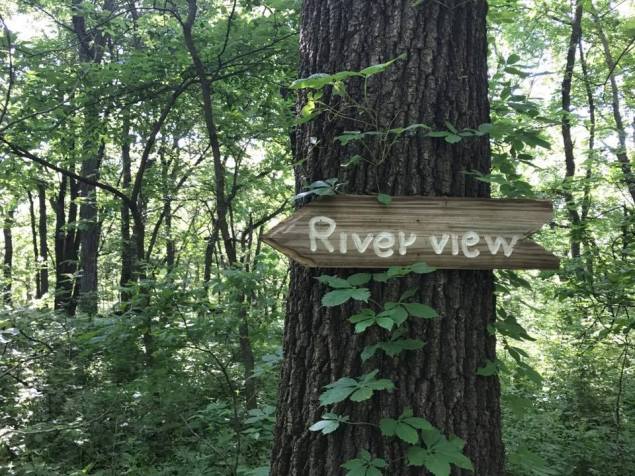
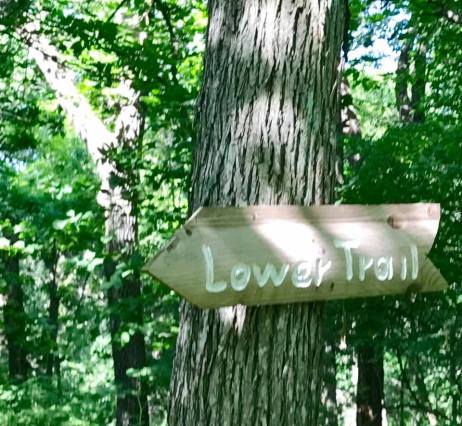
Wait, what? Hmm, a choice of two paths—the lower trail or the River view trail. I choose the river view…the whole point of the hike, right?
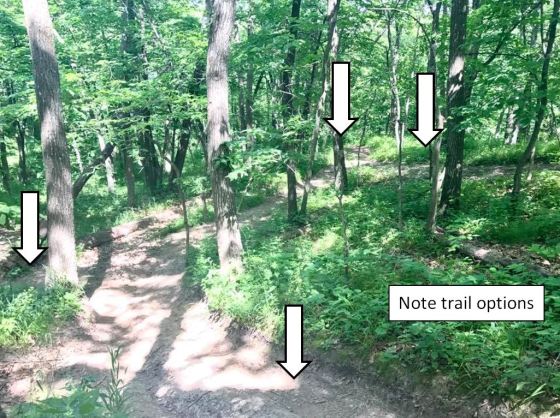
Wrong. Note: this necessary decision is not on the map. I hike to the river view and sit for a moment on a bench to view a sliver of the river. Hiking to the left, I find an even steeper decline than the day before. Hiking to the right, a dead end.
I hike back to the original choice of trails and take the lower trail.
I hike for about an hour (the time estimated for the hike) with many choices of trails (which I did not expect….remember, it’s a LOOP and not on the map). If there’s a wrong choice of trail to take, I take it.
I hit several dead ends: at the river, at a sign that reads “End of CU property”, at a few very steep inclines, and at a cave. My love of nature and the enjoyment of the journey is challenged. “Always we begin again” has been replaced with, “Will I ever get out of this maze?”
I considered turning back, but I just couldn’t bring myself to “begin again” two days in a row. It would take another hour to retrace my steps. Yesterday it was the right thing to begin again but today I need to focus on the present and future, and leave the past in the past. A lot like life, I think. “Always go forward and never turn back.” (St. Junípero Serra)
I consider walking the river until I meet a road; thinking surely there will be a road eventually. (So like some life situations: Can I just bail now?) I know this is the panic speaking so I retrace my steps back to a fork in trails and a sign that reads, “Upper Trail”.
Upper Trail is a hike up and up and up and up, likely one of the very steep trails I encountered the day before that I felt incapable of going down. I laugh. I take a short break for a few minutes…and then continue up and up and finally, I am on a walking path. I have to be close now. I see a shed. Wait, no, I don’t. Dear God, it’s a mirage. I laugh again at myself.
I consider taking an “after hike” selfie but know that it wouldn’t be web-worthy and would challenge the “sweat is good” attitude I’ve tried to attain. I realize I have seen NO ONE on the trail in over an hour. Have the others heard the trail isn’t really a loop? Thank God, I have my cell phone. Could I be found if I called for help? I don’t think it’s possible to die from thirst or hunger this close to….wait, I see a building. A real one this time.
I have arrived. Relief.
“In every walk with Nature one receives far more than he seeks.” -John Muir
I received more than I was seeking, no doubt. A simple loop hike turned into a frustrating and, in hindsight, funny experience. I took only short hikes for quite a few days, but as the end of the retreat neared, I knew I needed to challenge myself to the “loop” again. Surely, it would be easier now that I had done it.
The trails were familiar so I trusted myself and the route I chose. I hiked this time with a new set of eyes. I noticed things I hadn’t before—the signs seemed more clear and logical, sounds from each of the birds were clearly unique, a turkey family trotted quickly into the trees, blue insects escaped into cracks in the dirt, and there were forks in the path I hadn’t noticed before. But, this time I felt more comfortable being adventurous and going down those uncertain paths.
With experience behind me, I knew when I had come to the final fork in the trail. I hiked up the last hill and when I came out of the top, I realized, NO, that I was not at the end of the loop but at another offshoot! I laughed out loud. My confidence did not waiver; now I was able to trust where I was and navigate back to more familiar terrain.
Sometimes we must begin again. And when we do, we bring what we have learned from earlier efforts. I find this in my spiritual life as well. The more I pray, the more I trust. When I become afraid or anxious, I begin again. I go back to my faith, to prayer, and trust that God has been there before and always will be. I just need to begin again.
When we finally broke our silence at the end of the retreat, I realized I was not the only one that had this experience. Everyone else had gotten lost in the woods too. Now isn’t that just like life? There are no new problems under the sun.
No one, not even our closest soul friends can “hike the loop” for us, but, thankfully, they share with us solace, encouragement, and prayers.This journey is our own. We learn on the way. We are accompanied. And always we begin again
And for future hikes—this is a better idea of what the map should look like.
“There are hundreds of ways to kneel and kiss the ground.” –Rumi
There are many ways to pray—in song, spoken or written words, silence, creativity, nature and movement, just to mention a few. Paul recommends to “pray without ceasing” (1 Thessalonians 5:17), which is only possible if we are able to connect with our Creator in a variety of ways. We are meant to engage our senses, our whole bodies, in prayer.
I’ve come to appreciate this about the Catholic Mass, even if visitors might think there is a lot of up and down. We genuflect, sit, stand, kneel and bow. These gestures, postures or movement help to bring our whole being into prayerful expression—raising our hands when saying the “Our Father”, making the sign of the cross or receiving the Eucharist allows us to use our bodies in prayer.
In addition, walking the stations of the cross or a labyrinth, taking a nature hike, or practicing yoga or tai chi are prayerful forms of movement that engage our bodies while quieting our mind.
This summer I had the opportunity to pray in many ways while attending an eight-day Ignatian retreat at the Creighton University Retreat Center. Each day, for about an hour, I met with a spiritual director to receive guidance and to share my faith journey; the remainder of the day was spent reflecting on these discussions and praying. One of the ways that I prayed was by walking a labyrinth.
“A labyrinth is not a maze. A maze is a symbol of life without meaning, it is an agent of confusion, deception with dead ends that lead you nowhere. But a labyrinth is a symbol of a life of deeper meaning, an on-going sacred journey leading us inward, outward and to greater wholeness.” –Carrie Newcomer
There is a clear design to a labyrinth with only one path to reach the center, albeit not direct, and the same path to walk from the center outwards. Bringing one’s prayer to the labyrinth helps engage the mind, body and spirit.
“The labyrinth is an archetype, a divine imprint, found in all religious traditions in various forms around the world…Walking the labyrinth is a spiritual discipline that invites us to trust the path, to surrender to the many turns our lives take, and to walk through the confusion, the fear, the anger, and grief that we cannot avoid experiencing as we live our earthly lives.” Rev. Dr. Lauren Artress
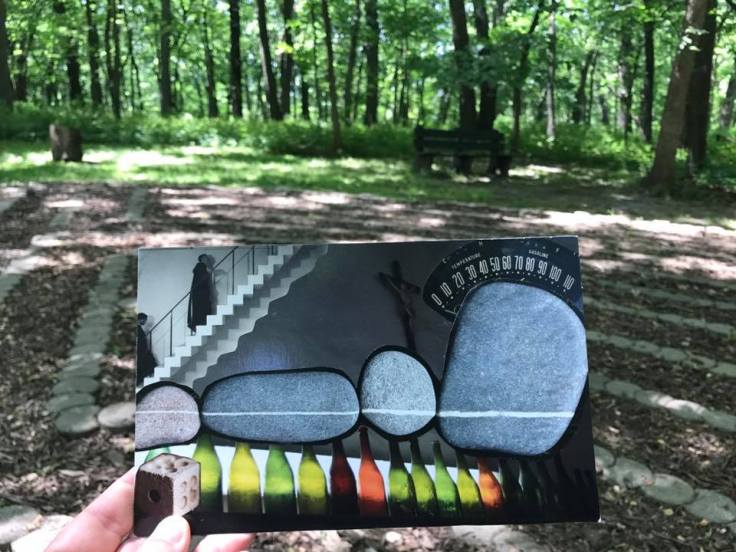
Often before starting a labyrinth walk, I offer an intention, ask a question, or prayerfully surrender a situation to God. Sometimes I carry a SoulCollage® card with me as I journey towards the center. Because there is only one path inward, the mind can let go of how one while arrive at the center. It is a certainty that I will get there eventually. I practice trusting that wherever God takes me, I will be led both inward to the center and back out. I can settle into a knowing that God is with me, that God accompanies.
This walk, or journey inward, is a metaphor for life—really all situations, relationships and decisions are a journey. So often we don’t know where we are headed, even with the best of plans or intentions. With a labyrinth walk, one has the experience of letting go of their own plan—surrendering and trusting that the center will be reached. It is nearly impossible to rush through a labyrinth. Just imagine what that might look like at the turning points. It is actually dizzying to make the turns, circling around from one quadrant to another, if moving too fast. The best option for the labyrinth (and perhaps for all of life) is to move in a rhythmic, slow, meditative walk.
Despite the appearance of a dead end, or another switchback, the journey continues inward and will ultimately arrive at the center. The route isn’t always clear. I often wonder if I somehow lost my place. Am I just walking in circles? There may be a bit of anxiety, but trusting that the path is the right one brings freedom. If this can be transferred to our life’s journey, imagine what that freedom might be like! Wherever God takes me, whether I am led inward or back out, when I feel I’ve lost my way or the walk feels longer than it should, I am reminded that God holds the divine design to our personal journey.
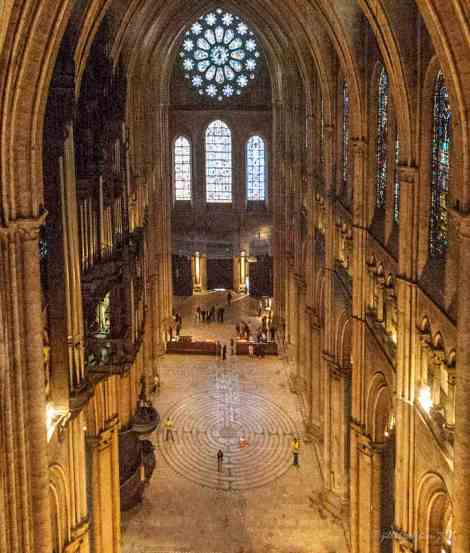
When I arrive at the center of the labyrinth, I surrender my intention, rest and pray. Recently I learned the labyrinth in the Chartres Cathedral is situated where the womb of Mary would be if the cathedral itself symbolized the head, arms and body of Mary (see Bishop Robert Barron’s description of the Chartres Cathedral and the image of Mary). It is a beautiful image to bring one’s prayer and concerns to the womb of Mary, surrendering into Jesus who surrendered for us. God makes our offering into something new; through our surrender, something in us can be birthed or transformed. The labyrinth, of course, is a symbol of this—we can surrender anytime. We are called to, as Jesus said, “Follow me”.
Chartres Cathedral Labyrinth completed in 1220, France
Bishop Robert Barron describes the stained-glass window, perfectly shaped to reflect on the labyrinth, as a symbol of heavenly light shining on the womb of Mary, receiving the light of Christ as the bearer of the divine word. Spending time in the center of the labyrinth, we can make personal Mary’s acceptance, “Be it done unto me (Luke 1:38).” We surrender as Mary did when she received the news from the angel Gabriel in the Annunciation.
“Growth is a spiral process, doubling back on itself, reassessing and regrouping.”-Julia Cameron
The journey outward is a continued expression of the prayerful surrender. It occurred to me while walking outward that I was moving more quickly. I was in a bit of a hurry even. Almost as if to say “I surrender, but please, answer my prayer quickly” or “There, I did it! I surrender. Done!” I am aware that I prefer difficult situations to be “fixed” now. I want a resolution; I don’t want to wait for an answer or solution. I don’t want the pain of the journey. I want to get straight to the center and back out again. Of course, the hurrying really doesn’t work. Staying attentive and slowly walking the walk is the only way to stay in God’s presence, to truly surrender.
Walking the labyrinth brings new insights each time—about the process itself, as a metaphor for life’s journey, and about the situation in need of prayer. Praying while walking a labyrinth can be combined with many other forms of prayer as well.
A SoulCollage® card I made to represent a recent dream.
I love labyrinths and am so excited about one being built at St. Benedict Center! “Its model is the famous labyrinth in the Cathedral of Chartres, France. When the Holy Land was closed to pilgrims in the Middle Ages, labyrinths abounded in the churches of Europe. They were used to symbolically represent the pilgrimage to the Holy Land. Our life is a pilgrimage, a journey to our eternal home with God in heaven.” –Father Thomas LeitnerThe labyrinth will be completed by spring 2018.
Consider attending a retreat I am leading hosted by St. Benedict Center called Living in the Fullness of God, October 27-28, 2018. Through prayer, we grow in the fullness of relationship with God. “The fullness of joy is to behold God in everything” (Julian of Norwich). What does it mean to live life to its fullest? Is it possible to always live with joy? Explore the paradox of embracing joy and sadness, light and darkness, birthing and dying, God in all and God within as we explore our greatest joy—that we are created in the image of God and we are created to create! Embrace the fullness of God’s gift of creative prayer including lectio divina, SoulCollage®, guided meditation and a labyrinth walk.







 I had no idea what I was creating when I started, with no goal in mind. I was drawn to the older women sharing stories and enjoying each other’s company. They look experienced (not old, please), rested, peaceful, connected, comfortable and wise. I imagined what it was they might be discussing. Perhaps the storms of life, the many changes they had experienced, their efforts to rise or reach or resist, obstacles they had overcome, obstacles that made them feel all shot-up and yet, in the end, still standing, still sitting, still connecting, still enjoying.


![702848[1]](https://soulfullyyou.net/wp-content/uploads/2017/09/7028481.jpg?w=736)

 Marriage includes the necessary and mundane—doing laundry, taking out the trash, paying bills, fixing, washing, mowing, checking things off the list of things to do, arguing about checking things off, thanking each other for checking things off.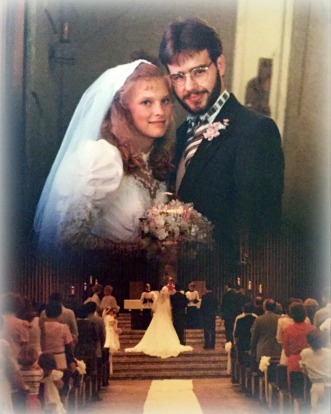

 Yup, that’s me, queen of procrastination. It probably doesn’t matter what the title is, but I will likely spend as much time considering the title as writing this post. I have to get back to my studies so, of course, this is a perfect time for the cloud of procrastination to cover all reasonable attempts to get something done.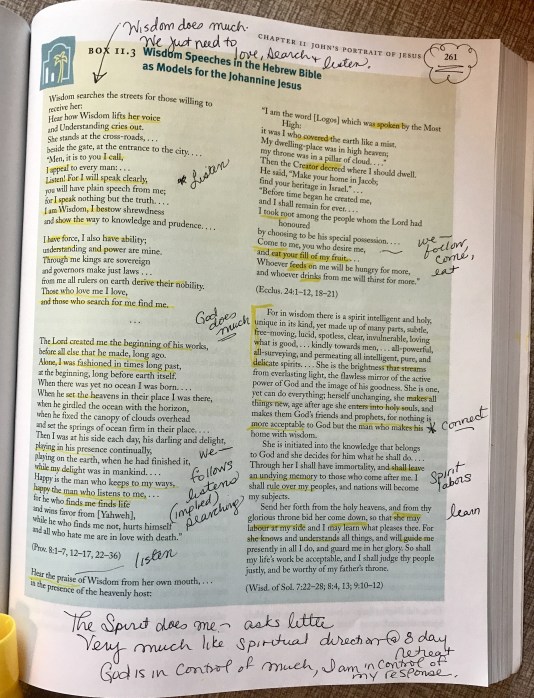


 There are many ways to pray. Really all of life can, and should, be a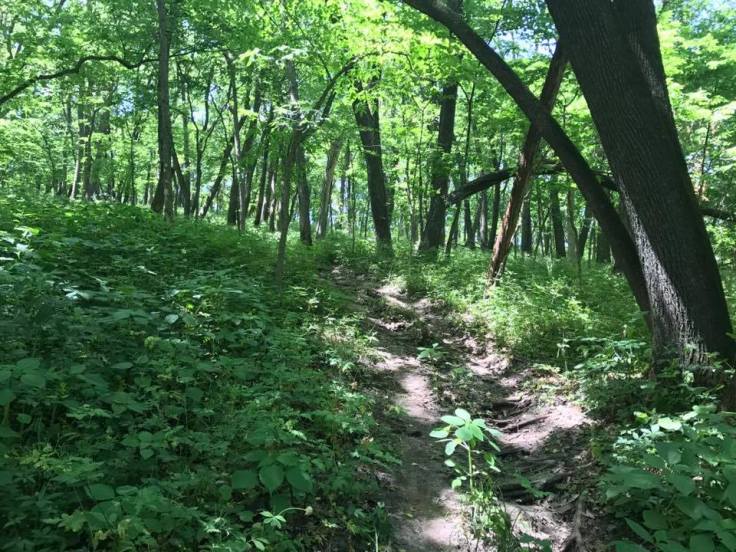






 In addition, walking the stations of the cross or a labyrinth, taking a nature hike, or practicing yoga or tai chi are prayerful forms of movement that engage our bodies while quieting our mind.



 SoulFully You